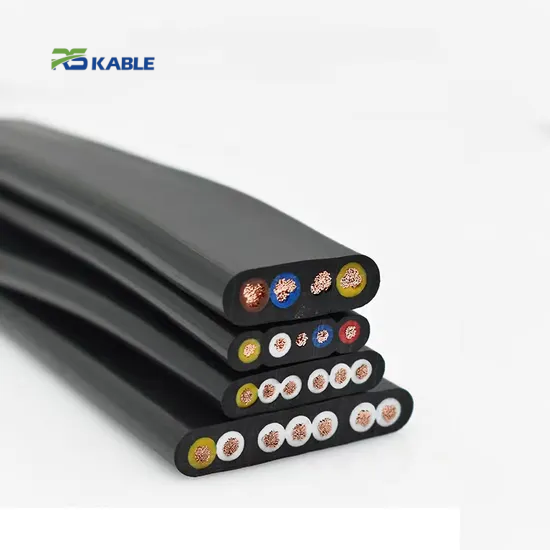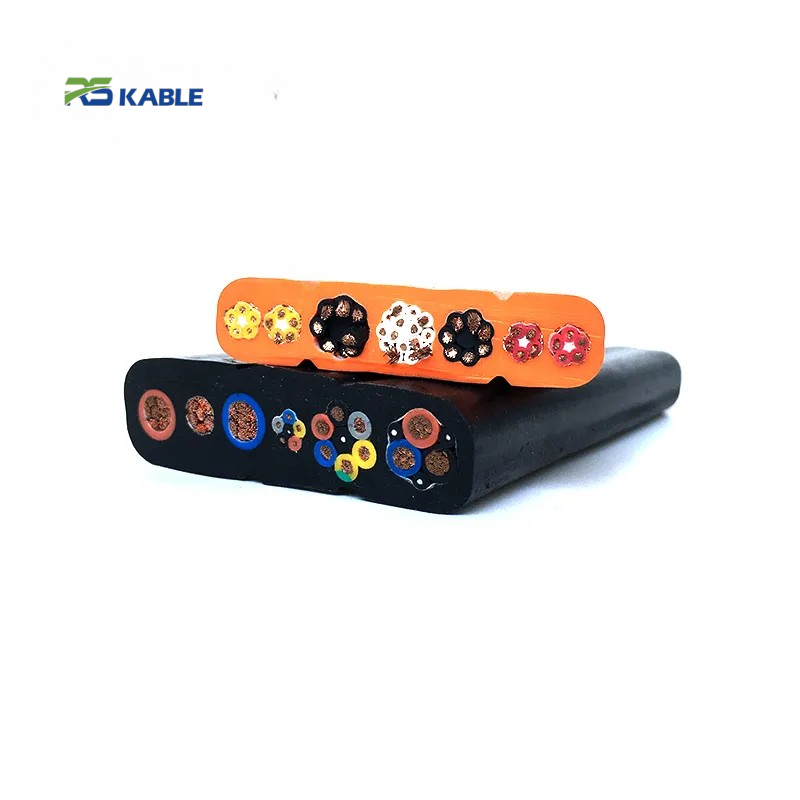


What Is a Festoon Cable?
A festoon cable is a flexible industrial cable designed to move continuously in a festoon system—a cable management setup where the cable is suspended in controlled loops and carried along a track by trolleys. Instead of dragging on the floor or twisting freely in the air, the cable travels in an organized path while delivering power, control signals, or both to moving equipment such as cranes, hoists, transfer carts, and automated material-handling machines.
That’s the definition. But what most buyers and maintenance teams really want to know is: why do festoon cables fail early, and how do you choose the right one so the system runs reliably for years rather than months? This guide answers those practical questions with an installation-focused approach, including the most common failure symptoms, a simple selection decision matrix, and a clear comparison between flat and round designs.
If you are specifying a cable for an overhead crane, port equipment, factory hoist line, rail transfer cart, or any trolley-based moving system, this article will help you make a safer and more cost-effective decision.
Festoon Cable vs “Regular Flexible Cable”
Many cables are “flexible,” but a festoon application is a different duty profile. A standard flexible cable might bend occasionally. A festoon cable is expected to:
-
bend repeatedly in predictable cycles as the machine moves
-
hang in loops under its own weight
-
endure constant clamp and support-point stress
-
survive vibration, acceleration, and direction reversals
-
maintain stable electrical performance under motion
If you install a fixed-installation cable (or an ordinary flexible cable) in a festoon system, common problems appear quickly: jacket cracking, conductor fatigue, uneven loop formation, or intermittent control faults.

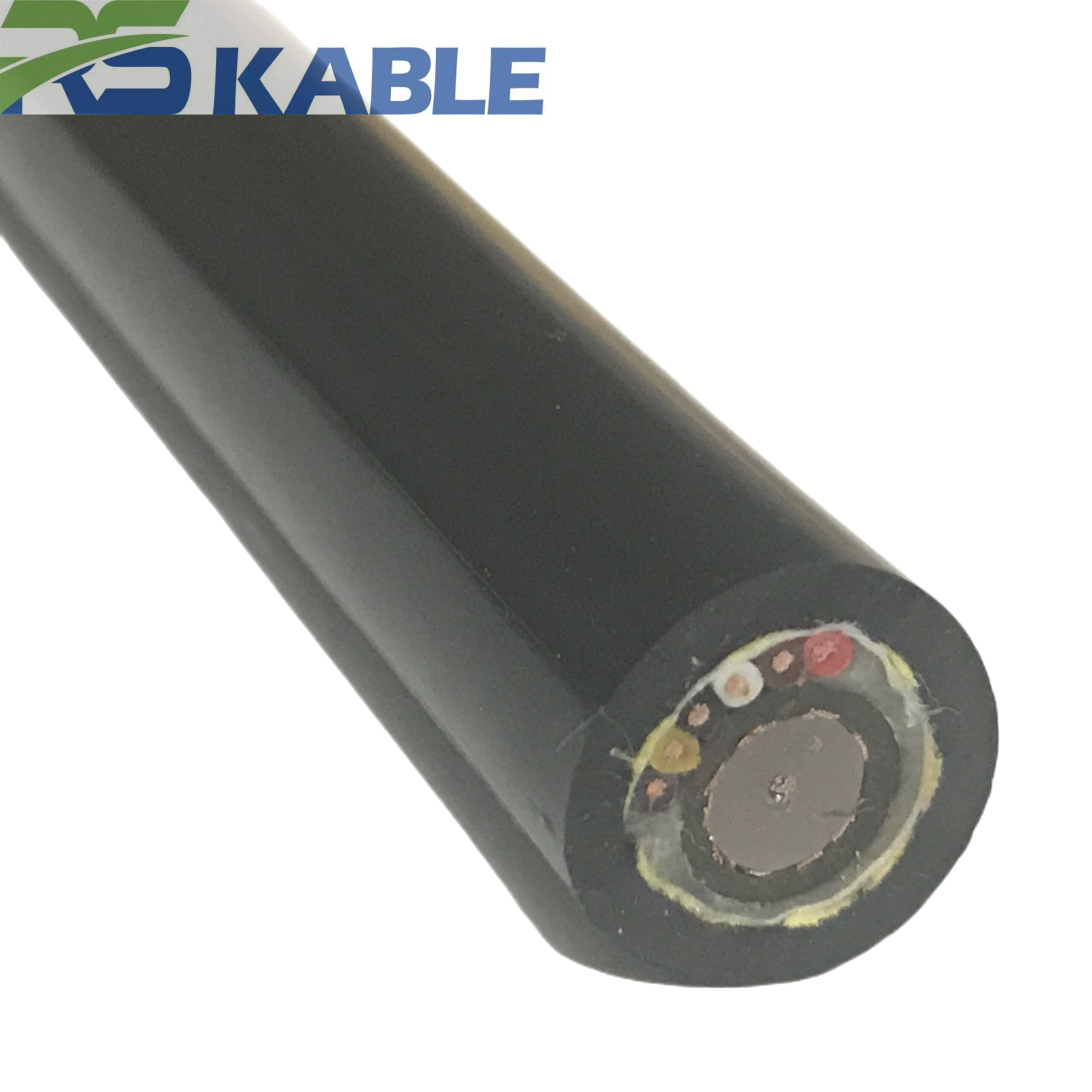
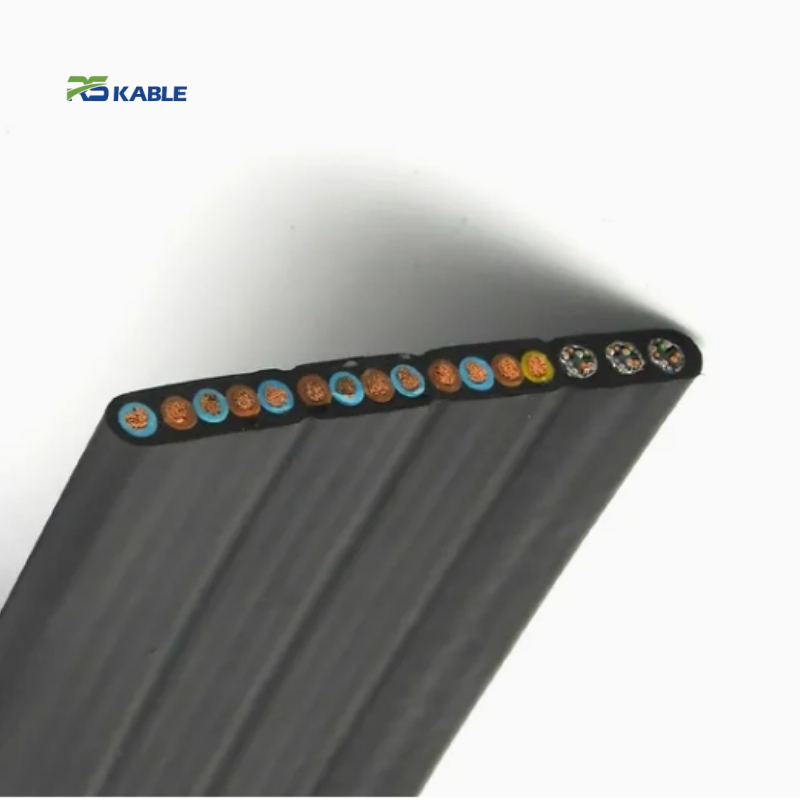
24×0.75mm Industrial Elevator Travelling Flat Cable – PE Insulated Bare Copper – Cat5e/Cat6
This hybrid elevator travelling flat cable combines **24 power cores (0.75mm²)** with **shielded Cat5e/Cat6 data pairs**, featuring **PE-insulated signal conductors**, **high-flex stranded bare copper**, and a **special soft PVC outer jacket** for reliable power delivery, stable data transmission, and long service life in dynamic lift systems.
How a Festoon System Works (and Why the Cable Matters)
A typical festoon system includes:
-
a track/beam (I-beam, C-rail, or similar)
-
trolleys (carriers that roll along the track)
-
cable clamps and strain relief points
-
the moving machine (crane bridge, hoist trolley, transfer cart)
-
the cable suspended in loops
As the machine moves, the trolleys travel and the loops open and close. The cable must flex smoothly and consistently. If the cable twists, stiffens, or wears unevenly, the loop geometry collapses—causing rubbing, snagging, or accelerated wear.
That is why cable selection is not a detail. It’s part of the motion system.
Where Festoon Cables Are Used
Festoon systems remain popular because they are robust, serviceable, and cost-effective across many industries, including:
-
Overhead cranes & bridge cranes (power + control for trolley motion)
-
Hoists and monorails (repeated guided travel)
-
Ports, shipyards, and bulk terminals (outdoor, high-duty cycles)
-
Rail transfer carts (power/control to mobile loads)
-
Conveyors and material handling lines (track-based movement)
-
Stage and event machinery (repeatable motion, tidy cable routing)
In many of these applications, a Flat Festoon Cable is widely preferred because it tends to hang and track more predictably in trolley systems.
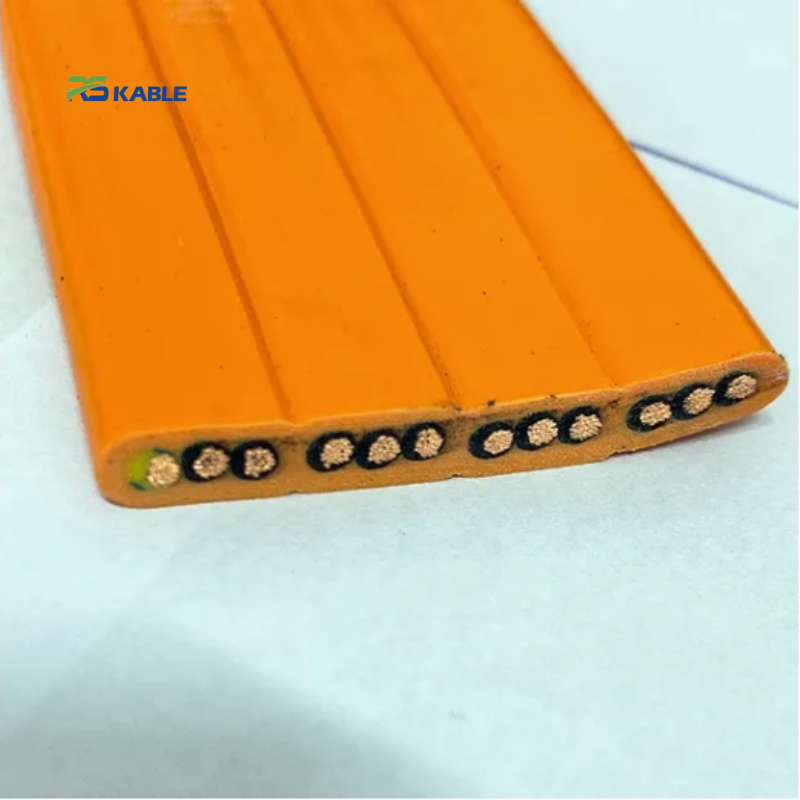
Why Flat Festoon Cable Is Often the Best Choice
A Flat Festoon Cable is built with conductors arranged in a flat profile rather than a round bundle. In trolley-and-loop systems, this shape can deliver important practical benefits:
-
less twisting during travel
-
more stable loop formation (cleaner, more repeatable loops)
-
better alignment in clamp and carrier systems
-
easier organization when multiple functions are combined (power + control)
In crane and hoist applications—especially where the travel is frequent and the system is sensitive to cable rotation—a Flat Festoon Cable often reduces mechanical instability and extends service life.
Common Festoon Cable Failure Symptoms and Root Causes
This is the section most installers and maintenance teams care about—because it maps real symptoms to actionable causes.
1) Twisting loops and unstable hanging behavior
What you see: loops rotate, tangle, or “walk” sideways; cable rubs on adjacent loops or track hardware.
Common causes: wrong cable geometry (often round when flat is needed), poor trolley spacing, incorrect clamp orientation, insufficient cable balance.
2) Jacket wear at the same location repeatedly
What you see: abrasion or flattening at recurring points—often at clamps, trolley contact points, or near ends.
Common causes: misaligned carriers, cable rubbing due to uneven loop length, abrasive surfaces, jacket material not suited for the environment.
3) Cracking or hardening of the outer sheath
What you see: surface cracks, stiffness increase, sheath “aging” faster than expected.
Common causes: wrong jacket compound (UV/weather exposure outdoors), chemical/oil contact, temperature extremes.
4) Intermittent control faults or signal noise
What you see: random sensor dropouts, control instability, faults that appear only during movement.
Common causes: conductor fatigue from repeated bending, insufficient shielding, poor core stability, clamp stress near terminations.
5) Early conductor fatigue near clamps or transition points
What you see: failures cluster near the same support points; electrical issues show up before the jacket looks fully damaged.
Common causes: too-small bend radius, excessive clamp pressure, wrong trolley spacing, cable not designed for high flex cycles.
If your system shows any of these patterns, the root issue is usually not “bad luck.” It’s a mismatch between cable design and real duty conditions.
Festoon Cable Selection Decision Matrix (Fast but Practical)
Use this simple decision matrix to choose a cable that fits the application rather than just “fits electrically.”
Step 1 — Define the motion duty
-
Travel length: short / medium / long
-
Speed: low / moderate / high
-
Duty cycle: occasional / daily / continuous
Higher speed and higher duty cycle increase fatigue risk. If the system runs all day (ports, terminals, production lines), select for endurance first.
Step 2 — Confirm system geometry
-
trolley spacing and loop size
-
clamp style and clamp pressure
-
minimum bend requirements in the loop
-
end transitions and strain relief
A good cable can still fail early if loop geometry forces tight bending or uneven hanging.
Step 3 — Match the environment
-
indoor vs outdoor
-
UV exposure
-
oil/grease contact
-
dust/abrasion risk
-
temperature range
Outdoor port systems often fail early due to jacket mismatch, not conductor mismatch.
Step 4 — Choose shape: flat vs round
Choose Flat Festoon Cable when:
-
twisting has been an issue
-
the system uses trolley carriers along a track
-
stable loop formation is required
-
multiple functions are in one cable (power + control)
-
high travel repetition or high duty cycle is expected
Round cable may be acceptable when:
-
twisting risk is low
-
the system design supports stable loop behavior
-
travel and duty cycle are moderate
Key Technical Features to Check Before Buying
Conductor design for repeated flex
Fine-stranded copper conductors are typically preferred because festoon systems create repeated bending cycles.
Core stability and insulation quality
A stable core layout helps the cable bend evenly, reducing internal stress concentration.
Jacket material and durability
Select jacket materials based on abrasion, oil/grease, and UV/weather requirements. This is often the #1 factor in outdoor failures.
Shielding (when control signals matter)
If the cable carries control or sensor signals near power cores or industrial EMI sources, shielding can improve stability.
Clamp compatibility
The cable must tolerate clamp pressure and repeated stress at suspension points. Poor clamp compatibility shortens life quickly.
Flat Festoon Cable vs Round: A Clear Rule of Thumb
If the cable is expected to hang in loops on trolleys all day—especially on cranes and hoists—start with a Flat Festoon Cable unless there is a specific reason not to. The stability advantage alone can reduce twisting and uneven wear, which are two of the most common field complaints.
In other words:
-
Round cable can work
-
Flat cable usually works more predictably in trolley-based festoon motion
That predictability often translates into fewer failures and fewer maintenance interventions.
Common Buying Mistakes to Avoid
-
Choosing only by voltage and cores
Electrical fit does not guarantee mechanical survival in a festoon system. -
Ignoring loop geometry
Wrong trolley spacing or tight loop bending kills cables faster than most buyers expect. -
Using indoor cable outdoors
UV and weather exposure can destroy the jacket early. -
Treating flat and round as interchangeable
A Flat Festoon Cable is often specified for a reason: stable movement. -
Buying the lowest-cost option for high-duty systems
In ports and heavy industry, downtime usually costs more than the cable.
FAQ
What is a festoon cable used for?
It supplies power and/or control signals to moving equipment in a trolley-based festoon system, such as cranes, hoists, and transfer carts.
Why does a festoon cable twist during travel?
Common causes include unstable loop geometry, incorrect trolley spacing, clamp alignment issues, and using a round cable where a flat design is better.
Flat festoon cable vs round: which is better for cranes?
In most trolley-based crane systems, a Flat Festoon Cable is preferred because it tends to twist less and forms more stable loops.
Can I use drag chain cable in a festoon system?
Sometimes, but drag chain cable is optimized for cable chains, not hanging loop motion. Festoon duty often needs different mechanical behavior.
How do I choose jacket material for outdoor festoon systems?
Prioritize UV/weather resistance, abrasion resistance, and compatibility with oil/grease or dust exposure, based on the site conditions.