

ROV Cable Cost Factors: What Drives the Price of a Tether
The first question in almost every ROV cable inquiry is price. It is also the question that is impossible to answer accurately without knowing what the cable must do. ROV cable cost spans an enormous range — from under USD 8 per metre for a basic observation-class tether to over USD 180 per metre for a deep-rated scientific platform cable with multi-mode fiber and aramid strength members. That twenty-fold difference is not profit margin. It is engineering.
This article explains exactly what drives that range. It breaks down cost by the five factors that account for over 90% of the price difference between a basic tether and a premium one: conductor materials, fiber optic integration, armor construction, depth rating, and cable length. Understanding these factors does not just satisfy curiosity — it gives you the tools to evaluate competing quotes and identify where you are paying a premium for capability you do not need, or where a lower price is cutting a corner that will cost you in the field.
1. Conductor Materials: Copper Grade and Stranding Class
Why copper specification matters more than quantity
All ROV tether power conductors use copper. But copper is not a single material — it varies significantly in purity, stranding class, and surface treatment, and these variations directly affect both performance and cost.
Bare copper is the baseline. Tinned copper — the standard for marine cable applications — applies a thin layer of tin to each strand before stranding. The tin prevents oxidation of the copper surface during the cable’s operating life in a humid or saline environment. An oxidized conductor develops elevated surface resistance at the strand-to-strand interfaces within the conductor bundle. Over time, this increases the conductor’s effective resistance above its rated value — producing more voltage drop than the system was designed for. Tinned copper prevents this degradation. It adds approximately 4–6% to the conductor material cost. It is not optional for any ROV tether intended for marine or high-humidity deployment.
Stranding class and fatigue life
IEC 60228 Class 5 conductors use medium-fine stranding — adequate for static or low-cycle applications. Class 6 uses fine stranding, with more individual wires of smaller diameter per conductor. Each wire in a Class 6 conductor carries a smaller proportion of the bending load, distributing fatigue stress across more contact points and significantly extending fatigue life at tight bend radii.
For a 300 m tether in standard 2.5 mm² power conductor size, the material cost difference between Class 5 and Class 6 is approximately USD 0.40–0.65 per metre of finished cable. In terms of operational life, Class 6 conductors in high-cycle ROV deployment applications typically last 2–3× longer before showing fatigue-related resistance increases. For an operator running 600 deployment cycles per year, this difference represents the gap between a tether that lasts 18 months and one that lasts 42 months.
Copper conductor contribution to cable cost (300 m, standard 6-core tether)
Typical range: USD 3.50 – 7.20 per metre
Varies with conductor count, cross-section, stranding class, and London Metal Exchange copper price at manufacture date.
2. Fiber Optic Integration: The Single Largest Cost Premium
What fiber adds to the bill of materials
Optical fiber is the single component that most dramatically increases ROV cable cost in a custom tether. The fiber element itself — the glass strand and its 900 μm tight-buffer jacket — is relatively inexpensive. The cost premium of fiber integration comes from three other sources: the termination process, the connector hardware, and the manufacturing constraints the fiber imposes on the rest of the cable.
Fiber termination requires clean-room handling conditions during cable assembly, precision alignment tooling for connector installation, and a trained technician with specific fiber handling certification. The connector pair alone — a SubConn or equivalent wet-mate optical connector rated for the operating depth — costs USD 180–650 per end, depending on depth rating and pin count. A 300 m tether with fiber elements at both ends carries USD 360–1,300 in connector hardware cost before a metre of cable is manufactured.
Single-mode vs multimode cost difference
The fiber element itself contributes relatively little to the cost difference between single-mode and multimode options in a tether. OS2 single-mode fiber costs approximately 15% more than OM3 multimode fiber per unit length. On a 300 m tether with two fiber elements, this is under USD 30 in fiber material cost — not a meaningful cost driver.
The meaningful cost difference comes at the transceiver level. Single-mode laser transceivers cost USD 200–600 more per channel pair than multimode LED-based transceivers. This is a one-time equipment cost, not a per-metre cable cost, but it is part of the total system investment. For operators selecting between fiber options, the lifecycle calculation almost always favours single-mode: the bandwidth ceiling of multimode fiber (10 Gbps at 300 m, degrading at longer lengths) creates an obsolescence risk that single-mode eliminates entirely.
Fiber element contribution to cable cost (300 m, 2-fiber OS2 elements)
Typical range: USD 12.00 – 35.00 per metre
Wide range reflects connector depth rating, fiber count, and whether the termination includes factory-tested optical link budget verification. Non-connectorized fiber elements (to be terminated by the customer) are significantly cheaper.
The no-fiber vs fiber cost comparison
A 300 m tether with six copper cores and no fiber elements is a fundamentally different product from the same tether with four copper cores and two fiber elements. The fiber version is typically 35–55% more expensive per metre. That premium buys: unlimited bandwidth capacity for current and future sensors, immunity to EMI coupling from thruster power conductors, and a signal path whose performance does not degrade with tether length the way copper data conductors do.
For operators who know their current sensor suite will not exceed 100 Mbps total bandwidth and who will deploy at depths where copper Ethernet is reliable, the fiber premium is not justified. For operators deploying work-class ROVs with high-resolution sonar, multi-camera HD systems, or scientific instrument payloads that are likely to change over the vehicle’s operating life, fiber integration is the less expensive long-term choice — because the alternative is a tether replacement when the bandwidth ceiling is reached.
3. Armor Construction: Material, Layer Count, and Wire Grade
The cost gap between material choices
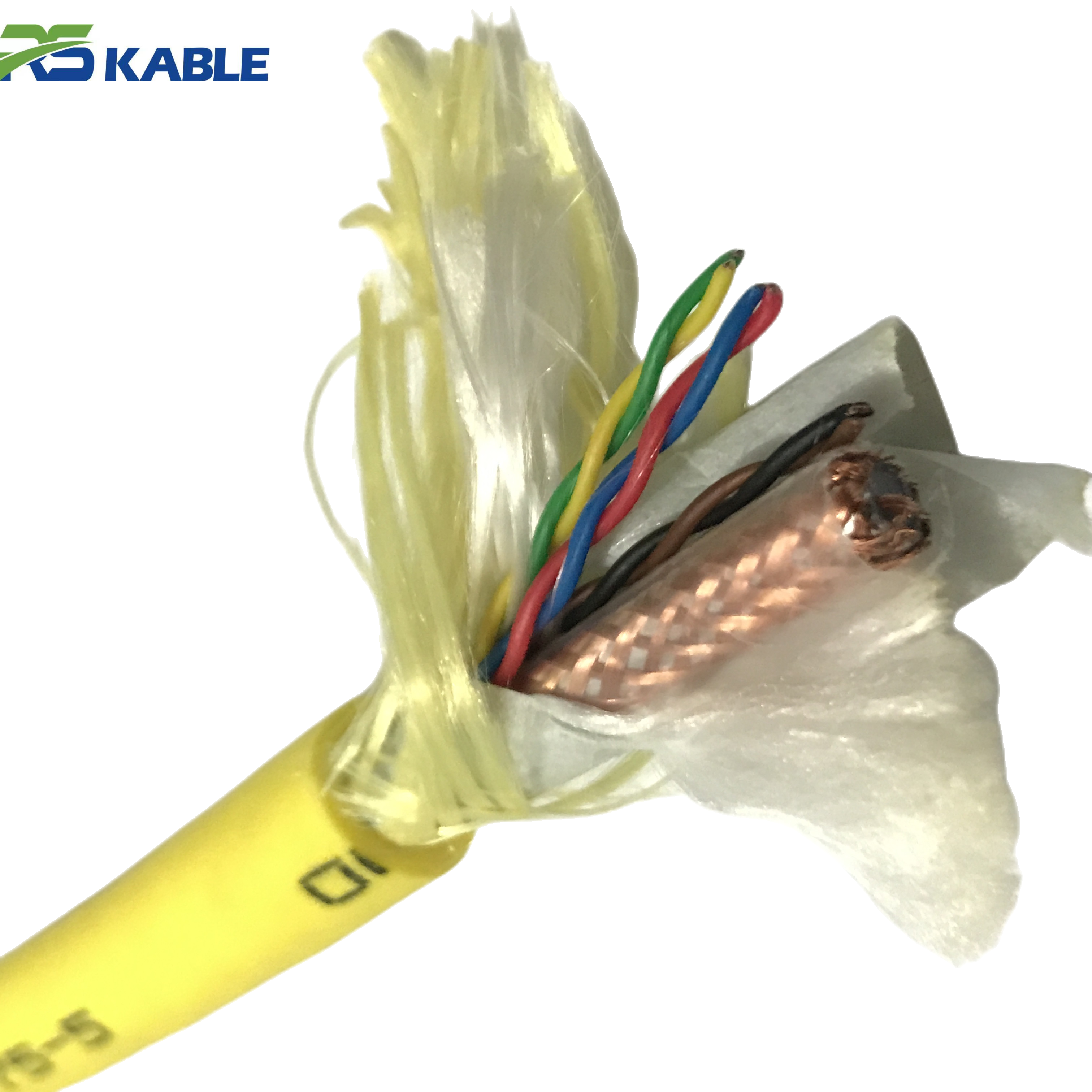
Armor material is the second largest cost variable in ROV tether manufacture. The three common choices are galvanized steel, 316L stainless steel, and synthetic fiber (aramid or Vectran), and their cost profiles are quite different.
Galvanized steel armor is the least expensive option per kilogram. It provides excellent tensile strength and good abrasion resistance. The limitation is corrosion resistance — galvanized coating degrades in continuous seawater exposure, and crevice corrosion between individual armor wires is a recognized failure mode in long-service offshore tethers. For short-service or freshwater applications, galvanized steel is a cost-effective choice.
316L stainless steel armor wire costs approximately 3–4× more than galvanized steel per kilogram, but provides substantially better corrosion resistance in saline environments. For any tether with a planned service life longer than 18 months in offshore seawater, 316L stainless is the correct specification. The incremental cost over galvanized steel on a 300 m tether is typically USD 600–1,200 — small relative to the cost of a premature tether replacement driven by galvanized armor corrosion.
Synthetic fiber strength members — Kevlar 49, Vectran, or HMPE (Dyneema) — cost 8–15× more per kilogram than steel wire, but weigh approximately 80% less at equivalent tensile strength. The economics of synthetic armor are compelling only when weight is a genuine constraint: neutral buoyancy designs where every gram of submerged weight must be offset by expensive foam filler, or deep-science platforms where total tether weight at depth affects vehicle station-keeping power.
Single armor vs double armor: the cost justification
Double armor construction — two counter-wound armor layers — adds approximately 30–45% to the armor contribution of the cable cost. It provides torque balance (critical for any application where tether rotation affects vehicle heading or sensor orientation), doubled crush resistance, and approximately twice the abrasion protection of single armor.
For observation-class ROVs on short, light tethers, single armor is almost always adequate and the cost saving is real. For work-class vehicles, structural inspection programs, and any tether that will contact abrasive seabed or structural elements during operation, double armor is not a luxury — it is the minimum protection level that will produce an acceptable service life. Specifying single armor to save cost on a work-class tether and replacing it in 14 months is more expensive than specifying double armor at the outset.
Armor contribution to cable cost (300 m, double-armor 316L SS)
Typical range: USD 6.50 – 14.00 per metre
Lower end: single armor, galvanized steel. Upper end: double armor, 316L stainless. Aramid fiber armor adds 20–40% above the upper end but reduces weight-in-water by 60–70%.
4. Depth Rating: The Cost Compound of Multiple Requirements
Why depth rating is not a linear cost increase
Depth rating affects ROV cable cost through multiple simultaneous requirements, each of which adds cost independently. A tether rated to 3,000 m is not simply a 300 m tether with thicker walls — it is a fundamentally different design in almost every component.
Insulation wall thickness must increase with depth rating to maintain dielectric withstand performance under hydrostatic compression. A 300 m-rated cable typically uses 0.6–0.8 mm polyethylene insulation wall. A 3,000 m-rated cable requires 1.5–2.0 mm wall thickness for the same voltage rating. This increases outer diameter and adds material cost at every insulation layer in the cross-section.
Jacket compound specification must address the cold-flow behavior of the material under high hydrostatic pressure. Standard PVC jackets deform progressively at pressures above approximately 200 bar — equivalent to 2,000 m water depth. Deep-rated tethers use high-density polyurethane or HDPE formulations tested to maintain dimensional stability at the rated pressure. These compounds cost 20–40% more per kilogram than standard marine PVC.
Tensile safety factor requirements increase with depth, because the cable’s own weight-in-water increases with deployment length. A 500 m tether with a negative buoyancy of 0.3 kg/m has 150 kg of tensile load from its own weight before the vehicle’s weight or drag forces are added. At 2,000 m, the same cable contributes 600 kg. The armor must be sized for these loads at the specified safety factor, which typically means heavier gauge armor wire and in many cases a transition from single to double armor construction.
Depth rating cost brackets
The relationship between depth rating and cost is not linear — it follows a step-function pattern, with significant cost increases at the transitions between pressure regimes that require different material and design approaches.
|
Depth rating |
Key design change |
Typical cost vs 100 m baseline |
Dominant cost driver |
|
< 100 m |
None — standard construction |
Baseline |
Conductor material and count |
|
100–500 m |
Improved jacket compound; heavier armor |
+15–30% |
Armor weight and grade |
|
500–2,000 m |
Deep-rated jacket; XLPE insulation; thicker walls |
+40–80% |
Jacket compound; insulation wall thickness |
|
2,000–4,000 m |
Syntactic foam bedding; pressure-tested connectors; heavier armor |
+100–180% |
Connector hardware; foam bedding; armor sizing |
|
> 4,000 m |
Full deep-sea spec; aramid/Vectran armor; specialty connectors |
+200–400% |
All components — every layer deep-rated |
Table 1. Depth rating cost multipliers relative to a shallow-water baseline tether. Percentages are indicative for a typical 300 m tether; exact values depend on conductor configuration, fiber elements, and armor specification.
5. Cable Length: The Economies and Diseconomies of Scale
Why longer is not proportionally more expensive
Cable cost per metre generally decreases with length due to manufacturing economics. Set-up costs — tooling changes, extrusion die installation, stranding machine configuration — are fixed regardless of how many metres are produced in a run. A 100 m reel carries all of these set-up costs. A 500 m reel spreads the same set-up costs over five times the length.
In our production data, the per-metre cost for a custom 6-core double-armor 316L tether is approximately 18–22% lower for a 500 m order than for a 100 m order of the same specification. This is not discounting — it is the genuine reflection of lower set-up cost amortization per metre of output.
The counter-force: weight and logistics
At very long lengths — above 800–1,000 m for work-class cable diameters — handling and logistics costs start to offset the manufacturing economies. A 1,000 m reel of 22 mm OD double-armor work-class tether weighs approximately 1,100–1,400 kg. Shipping a reel of this size by air freight (typically required for urgent offshore deployments) costs USD 4–8 per kilogram of cargo weight. The logistics cost on a single reel at this specification can approach the manufacturing cost of the cable itself.
This is a factor that operators sourcing long cables on short timelines should account for explicitly in their procurement budget. A cable that quotes at USD 85 per metre ex-factory becomes USD 105–115 per metre landed at an offshore port when air freight is factored in. Surface freight reduces this significantly but adds 3–5 weeks to the delivery timeline.
Minimum order implications
For short custom tethers — under 50 m — the minimum order quantity economics work against the buyer. The set-up cost of manufacturing a custom cable configuration is fixed regardless of length. A 30 m custom tether with a non-standard cross-section carries the same tooling and setup overhead as a 300 m reel of the same specification. The result is a per-metre cost that may be 3–5× higher than the long-run rate for the same cable specification.
For short lengths, it is worth asking the manufacturer whether they can supply from an existing run of the same or similar specification, rather than manufacturing a dedicated short reel. Manufacturers with active product programs often have short offcuts or partial reels available at significantly reduced per-metre cost.
6. What the Price Actually Tells You
The cheapest quote is not always the cheapest cable
The lowest ROV cable cost per metre is easy to find. What it represents is harder to evaluate without knowing the specification behind it. A tether quoted at USD 15 per metre and one quoted at USD 38 per metre for the same application may differ in:
- Conductor stranding class. Class 5 vs Class 6 — a fatigue life difference of 2–3× in high-cycle deployment.
- Armor grade. Galvanized steel vs 316L stainless — a corrosion resistance difference that manifests in 18–24 months of offshore seawater exposure.
- Insulation wall thickness. Minimum compliant vs rated with a safety margin — not distinguishable from a per-metre price comparison without the specification drawing.
- Testing documentation. Factory acceptance test certificate included vs manufacture without documented test results.
A tether that costs USD 12,000 and fails at 18 months costs USD 8,000 per year of service. A tether that costs USD 19,000 and lasts 48 months costs USD 4,750 per year of service. The cost per year of service is the relevant metric for any procurement decision, and it requires knowing both the price and the service life — which requires knowing the specification.
The questions that reveal specification quality
When evaluating competing quotes, ask each supplier the following questions. The answers will tell you more about the value behind the price than the per-metre number alone:
- What IEC stranding class are the power conductors? Class 5 or Class 6?
- What is the armor material? Galvanized steel, 316L stainless, or synthetic fiber?
- What is the armor construction? Single layer or double layer?
- What jacket compound is used? PVC, PUR, or HDPE — and what is the rated working temperature?
- Does delivery include a factory acceptance test certificate? With conductor resistance, IR, and HV withstand test results?
- What is the rated tensile safety factor? And how was the breaking strength verified?
“The inquiries that result in the best outcomes for the customer are the ones where the customer asks these six questions of every supplier. The answers create a specification comparison rather than a price comparison. In a specification comparison, the right cable usually wins — not always the cheapest cable, but the one that delivers the lowest total cost of ownership over its service life.”
7. Putting It Together: Indicative Cost Ranges by Application
The following ranges represent indicative total cable costs for complete 300 m tether assemblies in the described configurations. All figures are ex-factory and exclude shipping, connector hardware at the vehicle end (supplied by the vehicle manufacturer), and any third-party certification fees.
Observation-class, 100 m, copper-only, single armor
Typical range: USD 6 – 12 per metre
4–6 core, LV power, standard 48 VDC, galvanized or 316L armor, PUR jacket, no fiber. Suitable for inspection programs at depths to 100 m with modest data requirements.
Survey-class, 300 m, copper + 2-fiber, double armor 316L
Typical range: USD 28 – 55 per metre
6–8 core, LV or mid-range power, OS2 fiber for high-bandwidth sonar or HD video, double-armor 316L stainless, PUR jacket rated to 500 m. The most common specification for commercial inspection ROV programs.
Work-class, 500 m, copper + 4-fiber, double armor HV
Typical range: USD 65 – 110 per metre
8–12 core, HV power transmission (150–300 VDC), 4 OS2 fiber elements, double-armor 316L, deep-rated PUR jacket, rated to 1,000 m. Suitable for offshore oil and gas inspection and intervention programs.
Scientific / deep-rated, 1,000 m+, aramid strength member
Typical range: USD 120 – 220 per metre
Custom core configuration, HV power, 6–12 OS2 fiber elements, aramid or Vectran strength member for weight management, deep-rated jacket and connectors, rated to 3,000 m+. Deep-sea research and specialist offshore programs.
8. Price Is a Consequence of Specification
What this means for your procurement process
Understanding ROV cable cost drivers does not just help you evaluate quotes — it helps you build a specification that does not pay for capability you do not need. The operator who specifies 316L double armor for a freshwater dam inspection program that runs 80 cycles per year is paying a premium that galvanized single armor would cover perfectly adequately. The operator who specifies galvanized single armor for a North Sea jacket inspection program running 600 cycles per year per year in 15°C saline water will be replacing the tether in 14 months.
The specification determines the appropriate cost. The cost does not determine the appropriate specification. Work through the application requirements first, let the specification follow, and then evaluate quotes against that specification. That sequence produces the lowest total cost of ownership — which is the number that actually matters.
Want a cost estimate for your specific application? Send us your operating depth, tether length, vehicle power budget, and data requirements. We will return an indicative price range with the specification assumptions behind each figure — so you can compare it against other quotes on a like-for-like basis.
Frequently Asked Questions
Q1: Why do ROV cable prices vary so much between suppliers for the same specification?
Price variation between suppliers quoting the same specification has several legitimate causes and one illegitimate one. Legitimate causes: different raw material sourcing costs (copper price, armor wire grade), different manufacturing efficiency levels, different overhead structures, and different geographic production cost bases. The illegitimate cause is specification substitution — a supplier who quotes a lower price by using galvanized steel armor instead of the specified 316L, or Class 5 conductors instead of specified Class 6, or thinner insulation walls that technically pass the voltage rating but carry less safety margin. The only way to distinguish legitimate price competition from specification substitution is to request a specification drawing and acceptance test protocol with every quote, and compare them against each other. Suppliers who decline to provide these documents are not competitors worth evaluating.
Q2: Is it worth paying for factory-installed fiber optic elements if my current sensors do not need them?
It depends on the expected life of the tether and the trajectory of your sensor technology. If you are specifying a tether for a vehicle that will be in service for 5–7 years, and if there is any meaningful probability that future sensors will require bandwidth above 100 Mbps — high-resolution sonar, multi-channel HD video, high-rate acoustic positioning — then factory-installed fiber is likely to be less expensive than a tether replacement when the bandwidth ceiling is reached. If the tether is for a short-term program with a fixed sensor suite, the fiber premium is not justified. A useful rule: if you would have to scrap the tether rather than upgrade the sensors when bandwidth requirements increase, install fiber now. If the tether cost is low enough that replacement is a reasonable response to changed requirements, skip the fiber and revisit when needed.
Q3: How much does certification (DNV, Lloyd’s) add to the cost?
Third-party certification from DNV, Lloyd’s, or another classification society adds cost through two mechanisms: the testing and documentation requirements that must be met to obtain the certificate, and the certification body’s survey fee. For a standard ROV tether, DNV or Lloyd’s type approval typically adds USD 2,000–5,000 in additional testing cost to the first-article manufacturing process (this cost is amortized over the production run — it does not add USD 5,000 to every reel). The ongoing survey fee for class-certified delivery documentation is typically USD 300–800 per shipment. Certification is mandatory for some offshore operational contexts — DNV classification society clients often require it — and optional in others. If your operation does not contractually require it, the cost premium is generally not justified by the technical improvement it represents.
Q4: What is the most cost-effective way to reduce ROV cable cost without compromising performance?
Three adjustments consistently reduce cost without compromising performance for the actual application. First: be precise about depth rating. A tether specified to 1,000 m for a program that operates at 350 m maximum is paying for 650 m of headroom it will never use — in insulation wall thickness, jacket compound, armor weight, and connector rating. Specify to 120% of actual operating depth, not to the next round number. Second: match conductor stranding class to actual cycle count. Class 6 at USD 0.50 per metre premium is justified for 600-cycle-per-year programs. It is not justified for 80-cycle-per-year inspection contracts. Third: consider copper-only if your bandwidth requirements are genuinely below 100 Mbps at your operating length. Fiber integration at USD 15–30 per metre premium is only cost-effective when it provides capability that copper cannot deliver at the required performance level.
Q5: Why is armor material such a large fraction of cable cost?
Armor wire is typically the heaviest single component in an ROV tether by mass. A double-armor 316L stainless tether for a 300 m work-class application uses approximately 85–130 kg of stainless steel wire. At stainless steel market prices (USD 3–6 per kg for marine-grade wire), the raw material cost of the armor alone is USD 255–780 — before stranding, quality testing, and finished goods overhead are added. The armor also has the longest manufacturing lead time of any cable component: specialty armor wire for deep-rated applications is produced in limited production runs, and a supply shortage at the wire mill can add 4–6 weeks to a cable delivery timeline. This is why armor grade and construction should be decided at the application brief stage, not treated as a default that can be changed at quote acceptance.
Q6: How should I budget for replacement tethers over a 5-year ROV program?
Budget replacement based on expected service life rather than assuming the first tether will last the full program. Service life depends primarily on annual deployment cycle count, operating environment (freshwater vs seawater, abrasion risk), and whether the tether specification matches the actual fatigue demands of the operation. A correctly specified 316L double-armor tether in a 400-cycle-per-year offshore inspection program should last 36–48 months before conductor fatigue becomes a risk. At 700 cycles per year in a structurally complex environment, plan for 18–24 months. Over a 5-year program, this translates to 1.5–3 tether replacements, depending on the intensity of use. Budget accordingly — and note that the second and third tether replacements can often be partially offset by the operational knowledge gained from the first: operators who have run their first tether to end-of-life understand their actual cycle counts and environmental conditions well enough to specify the replacement more precisely, often at better value.