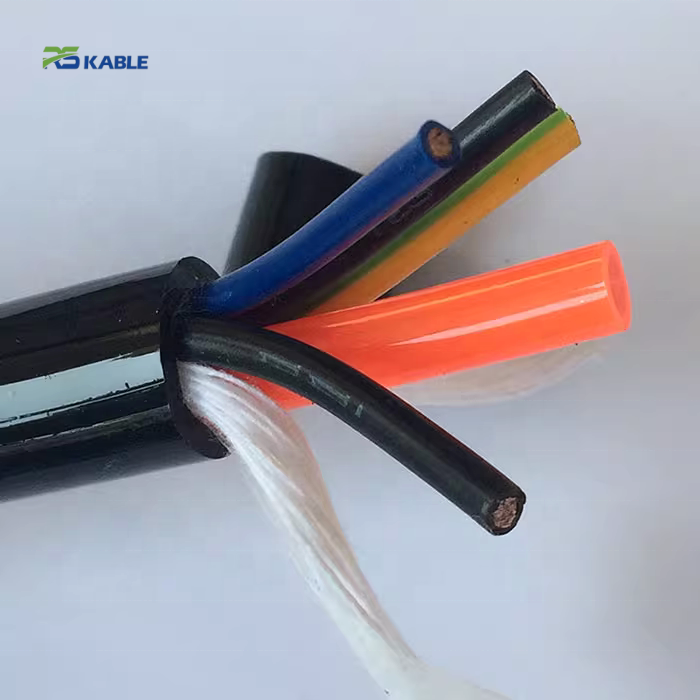



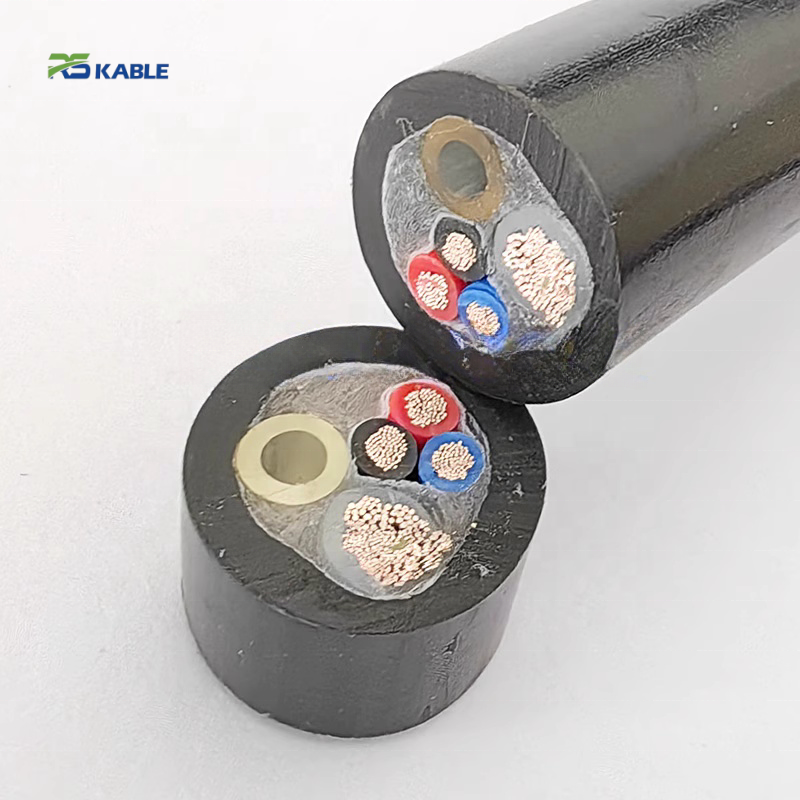
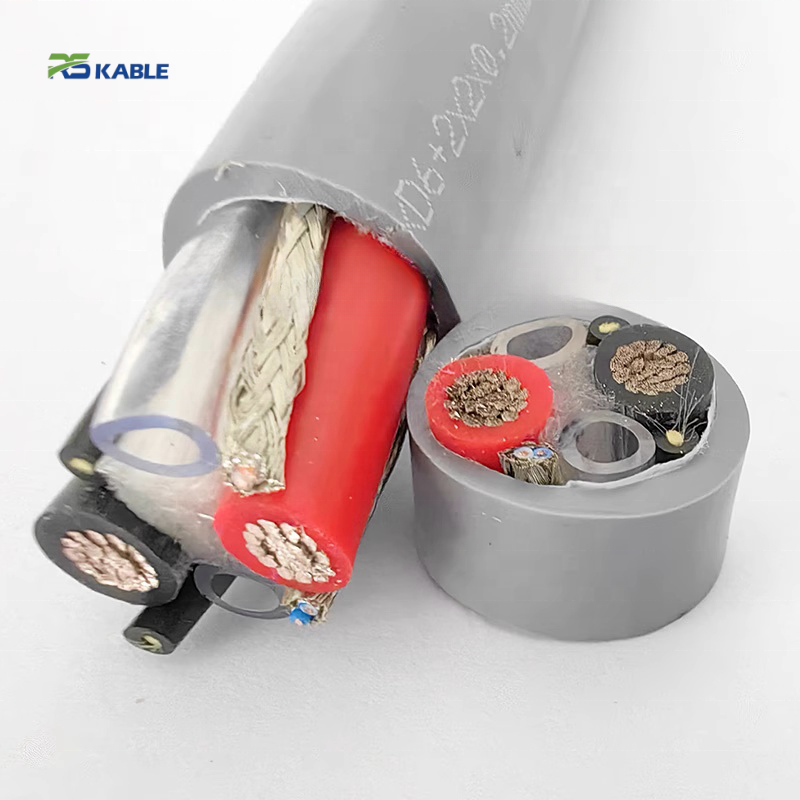
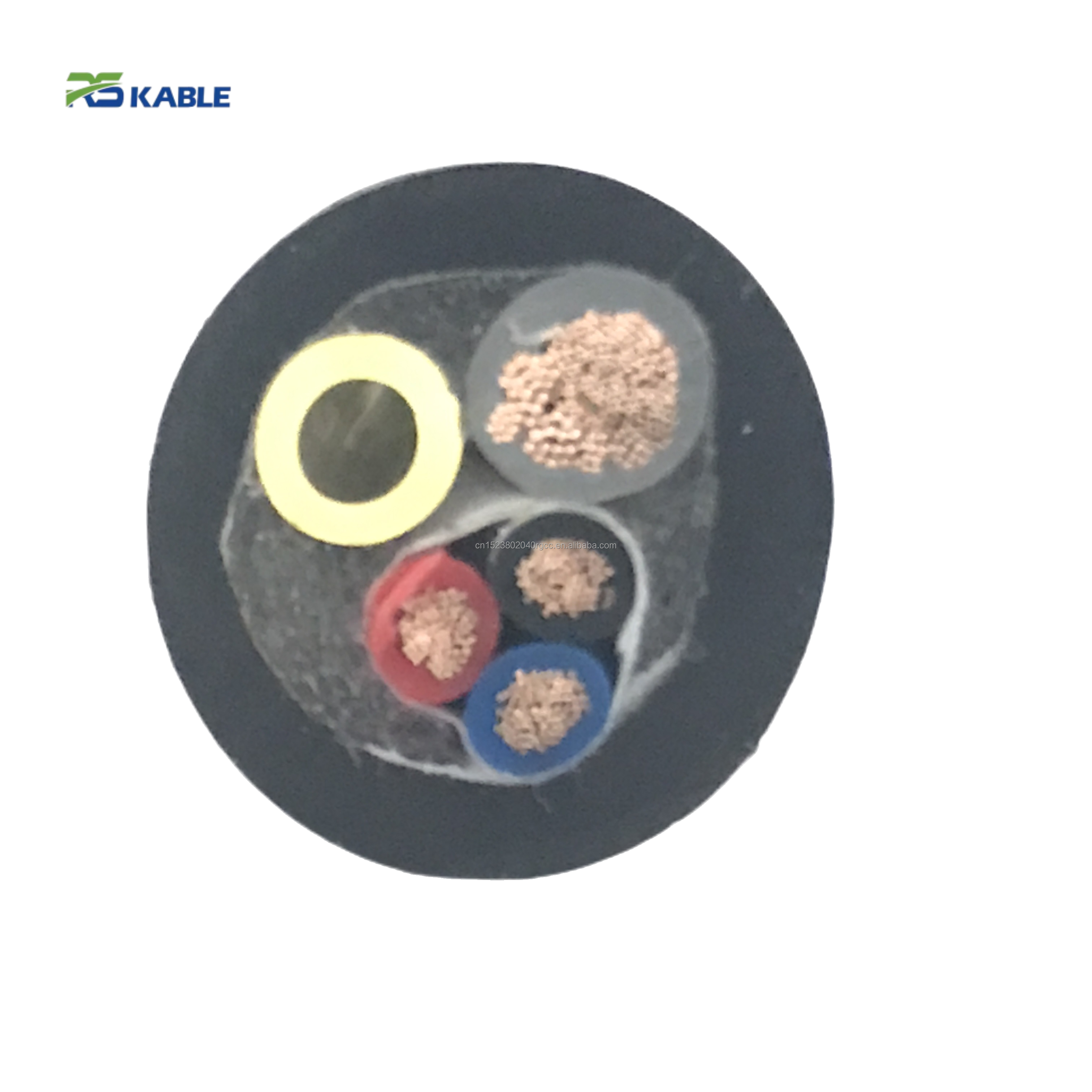
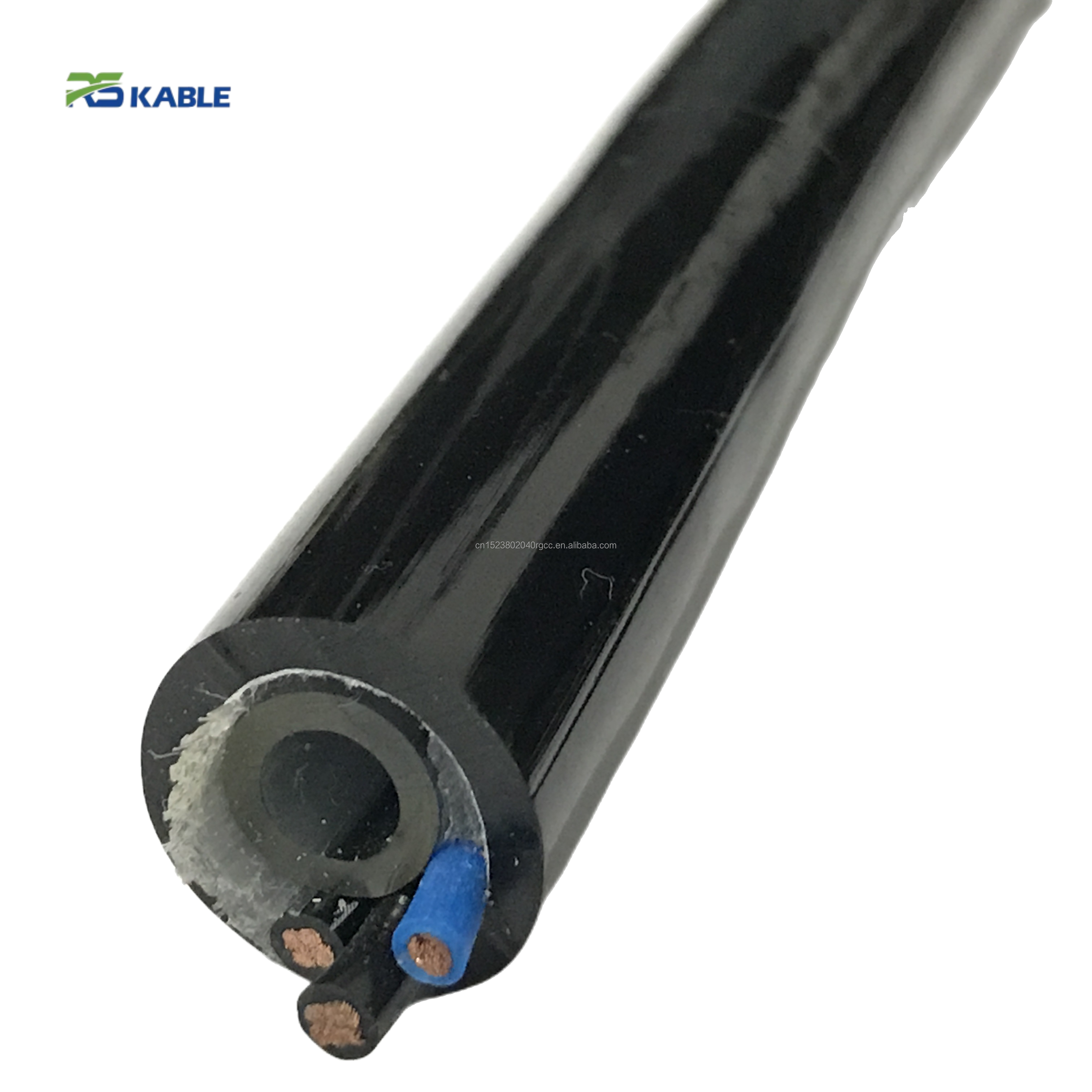
Medical Air Hose Cable | Integrated Pneumatic & Signal Cable for Healthcare Equipment
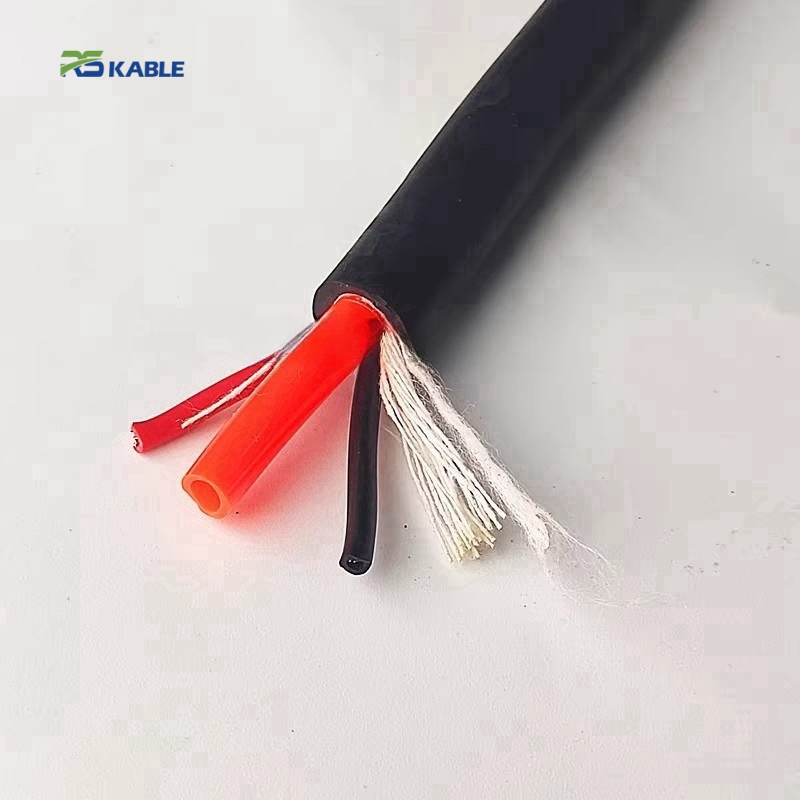
This hybrid cable integrates a medical-grade gas tube with signal and power cores in a flexible, sterilization-resistant jacket for demanding healthcare environments.
Key Benefits:
✅ Medical-grade materials (USP Class VI, silicone/PU)
✅ ≥3,000,000 flex cycles for long-term reliability
✅ Autoclave-resistant and biocompatible
✅ Compliant with IEC 60601-1 and ISO 10993
Ideal for surgical robots, ventilators, and medical systems, with full certification and custom options available.
Medical Air Hose Cable | Integrated Pneumatic & Signal Cable for Healthcare Equipment
|
Gas bore options |
Max pressure |
Flex life |
Sterilisation |
MRI safe (static) |
EMC shielding |
|
PU / Pt-Silicone |
8 bar |
≥ 3,000,000 cyc |
EtO · Gamma · 134°C |
< 1 μN torque |
< 20 mΩ/m |
|
USP Class VI / ISO 10993 |
Burst ≥ 4× rated |
4× OD, full assembly |
TPE-S jacket option |
3.0 T field tested |
Transfer impedance |
Three Questions That Determine Which RST-MH Variant You Need
Most specification errors on medical air hose cable orders come down to three decisions made without enough information: gas type, sterilisation method, and operating environment. Answer the three questions below before reading the detailed specification — they route you to the correct model and the correct bore material in under two minutes.
|
Question 1 — What gas will flow through the bore? Compressed air, N₂, CO₂, or N₂O at any pressure → medical PU bore is suitable. O₂ or O₂-enriched mixtures above 3 bar, or halogenated anaesthetic agents → platinum-cure silicone bore only. (PU bore is not rated for oxygen service above 3 bar — fire risk in O₂-enriched atmosphere.) Question 2 — What sterilisation method does your device undergo? Wipe-down only (IPA ≥ 70%, quat ammonium) → TPE outer jacket (standard). EtO or gamma irradiation → TPE outer jacket (standard); EtO rated to 60 °C. Steam autoclave 121–134 °C → TPE-S outer jacket required. TPE softens irreversibly above 110 °C. Question 3 — Does any part of the cable pass through or adjacent to an MRI bore? No → standard configuration is applicable. Yes → specify MRI-conditional flag at order. All RST-MH conductors are non-magnetic copper; however, MRI-conditional use requires additional deflection force documentation and RF heating characterisation — provided on request with the MRI technical file package. |
RST-MH Series Product Matrix
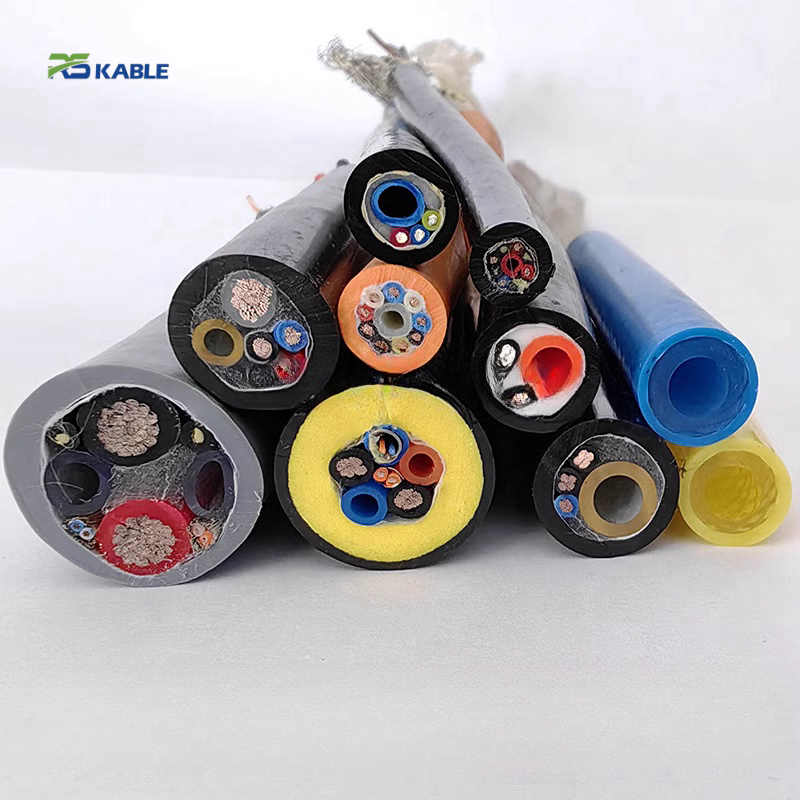
Seven standard configurations plus ETO. All models include a documentation package (material declarations, RoHS/REACH certificate, dimensional inspection report, extractables summary). Production in controlled-environment assembly area; lot traceability to raw material batch.
|
Model |
Signal / data |
Power cores |
Gas bore |
Bore ID |
Max bar |
OD (mm) |
Jacket / sterilisation |
|
RST-MH-110 |
4 × 0.34 mm² ctrl |
2 × 0.75 mm² |
1 × Med-PU |
4 mm |
8 bar |
11.5 ±0.4 |
TPE · EtO/Wipe |
|
RST-MH-120 |
2 × Cat5e pair |
2 × 0.75 mm² |
1 × Med-PU |
6 mm |
8 bar |
13.0 ±0.4 |
TPE · EtO/Wipe |
|
RST-MH-130 |
Cat5e + CAN bus |
2 × 1.5 mm² |
1 × Med-PU |
6 mm |
8 bar |
15.5 ±0.5 |
TPE-S · Autoclave 134°C |
|
RST-MH-200 |
2 × Cat5e pair |
3 × 1.0 mm² |
1 × Pt-Silicone |
4 mm |
6 bar |
14.0 ±0.5 |
TPE-S · Autoclave 134°C |
|
RST-MH-210 |
RS-485 + 4 ctrl |
2 × 0.75 mm² |
1 × Pt-Silicone |
6 mm |
6 bar |
15.0 ±0.5 |
TPE-S · Autoclave 134°C |
|
RST-MH-300 |
Cat6 + CAN + RS-485 |
2 × 1.5 mm² |
2 × Med-PU |
4 mm ea. |
8 bar ea. |
18.5 ±0.6 |
TPE · EtO/Gamma |
|
RST-MH-C (ETO) |
Per spec |
Per spec |
PU or silicone |
3–10 mm |
≤10 bar |
10–25 mm |
TPE / TPE-S / LSZH |
Complete Technical Specification
Electrical conductors and shielding
|
Parameter |
Specification |
|
Signal conductor |
Silver-coated fine-stranded copper, 7/0.20 mm. Silver coating prevents grain-boundary work-hardening that causes resistance drift in bare-copper conductors under repeated flex — critical in precision sensor and motor feedback circuits where a 5% impedance increase triggers a device fault. |
|
Power conductor |
Fine-stranded annealed copper, IEC 60228 Class 6; 0.75 mm², 1.0 mm², 1.5 mm² standard |
|
Insulation |
Medical-grade FEP (fluorinated ethylene propylene); USP Class VI; zero plasticiser migration; rated 200 °C — survives autoclave cycles without insulation softening; colour per IEC 60601-1 Table 1 on request |
|
Shielding — three levels |
(1) Individual pair AL/PET foil, 100% coverage + drain wire · (2) Inter-bundle tinned Cu drain braid · (3) Overall tinned Cu braid ≥ 90% optical coverage. Transfer impedance < 20 mΩ/m at 1 MHz across rated flex life. |
|
Impedance (data pairs) |
100 Ω ± 5%; verified at 0, 500k, 1M, and 3M cycle checkpoints to confirm no geometry-driven drift |
|
Rated voltage |
Signal cores: 60 V (MOOP per IEC 60601-1 Cl. 8.5) · Power cores: 300/500 V AC |
|
PE continuity |
≤ 0.1 Ω full cable length per IEC 60601-1 Cl. 8.6.4; verified each production lot |
|
EMC — IEC 60601-1-2 |
Shielding attenuation ≥ 40 dB at 100 MHz; supports 10 V/m radiated immunity (Ed. 4); allows cable to be included in device-level IEC 60601-1-2 test without additional conduit |
Pneumatic bore — gas service data including bend-state corrections
|
Parameter |
Specification |
|
Bore materials |
Medical polyurethane (USP Class VI) — standard · Platinum-cure silicone (ISO 10993-12) — O₂ / anaesthetic agent service. Both: no plasticiser, no DEHP, no BPA, bore surface Ra ≤ 1.6 µm |
|
Bore ID / wall thickness |
3 mm / 0.85 mm · 4 mm / 1.0 mm · 6 mm / 1.25 mm; ID tolerance ±0.15 mm. Wall thickness co-specified with cable bundle for bending stiffness balance ±12% |
|
Max working pressure |
PU bore: 8 bar (all IDs) · Silicone bore: 6 bar (4 mm), 6 bar (6 mm); burst ≥ 4× working (medical 4× vs industrial 3× safety factor); impulse test: 300,000 cycles at rated pressure per ISO 6945 |
|
Free-air flow (straight section) |
4 mm PU @ 6 bar: ~95 L/min · 6 mm PU @ 6 bar: ~215 L/min · 4 mm silicone @ 5 bar: ~85 L/min · 6 mm silicone @ 5 bar: ~195 L/min |
|
Bend-state flow correction |
Bore cross-section reduces as cable bends. At minimum dynamic bend radius (4× OD), correction factors apply to free-air flow values above: PU bore: 4 mm × 0.94 · 6 mm × 0.95 (elliptical distortion ~5–6% area loss) Silicone bore: 4 mm × 0.88 · 6 mm × 0.90 (silicone is softer; higher distortion under same bending force — ~10–12% area loss vs PU’s 5–6%) For O₂ breathing circuits and anaesthesia gas paths where delivered flow must be within ±5% of nominal: use silicone correction factors in circuit design. Do not use PU correction factors for silicone bore models. |
|
Extractables (bore) |
USP Class VI extraction: TOC in gas stream < 0.5 mg/m³ after 72 h conditioning at 23 °C; lot-specific extractables report available. Silicone bore: ISO 10993-12; catalytic residue (platinum) < 1 ppm |
|
Gas compatibility |
PU bore: med air (ISO 7396-1), N₂, CO₂, N₂O · Silicone bore: all above plus O₂ and halogenated agents (sevoflurane, desflurane, isoflurane). Neither bore: H₂, acetylene, HCN, or reactive oxidisers above 4 bar |
|
Medical fittings |
ISO 5356-1 conical (22 mm / 15 mm); DISS outlet; custom overmold. Strain-relief overmold at cable-to-fitting transition standard on all assemblies |
MRI compatibility — static field and RF heating data
|
All RST-MH conductors are non-magnetic copper alloys. The following data was generated on RST-MH-120 and RST-MH-200 representative samples at 3.0 T static field. |
||
|
MRI safety parameter |
Measured value (3.0 T) |
Assessment |
|
Deflection force |
< 1 μN (undetectable on 0.01 mg precision balance) |
Non-magnetic: deflection angle < 45° criterion per ASTM F2052 met by wide margin; MRI-conditional designation supportable |
|
Torque |
< 0.1 μN·m |
Below detectability threshold; does not contribute to rotational force on device |
|
RF-induced heating (1.5 T, 15 min SAR 2 W/kg) |
ΔT < 1.8 °C at cable surface; < 0.5 °C at 10 mm from cable |
Below ASTM F2182 threshold (< 5 °C acceptable for conditional use). RF heating is length- and routing-dependent — validate final cable route in device-level MRI test |
|
Image artefact |
Artefact extent < 10 mm at 3.0 T |
Acceptable for all applications where cable does not pass within 15 mm of the imaging ROI. Confirm placement geometry with imaging physicist for applications near the field of view |
|
Conditional labelling |
MRI Conditional per IEC 62570 definition |
Device-level MRI labelling (MR Conditional symbol per IEC 62570) requires device OEM to perform system-level validation at final cable routing; Rousheng provides component-level data package for inclusion in device technical file |
|
IMPORTANT — RF HEATING IS ROUTING-DEPENDENT The ΔT < 1.8 °C value above was measured on a straight 1-metre RST-MH-120 sample at 1.5 T, SAR 2 W/kg. RF-induced heating in implanted or routed cables scales non-linearly with cable length and depends critically on cable geometry (loops, parallel runs, proximity to RF coil). A cable that passes the component-level test may generate significantly higher ΔT in the final device installation. MRI-conditional device labelling requires device-level RF heating testing at the final cable routing configuration. Rousheng supplies the component-level data; the device OEM is responsible for system-level validation per ASTM F2182 and IEC 62570. |
Mechanical and environmental
|
Parameter |
Specification |
|
Flex life |
PU bore models: ≥ 3,000,000 cycles · Silicone bore models: ≥ 1,500,000 cycles; 4× OD dynamic bend radius; criterion: no conductor break, impedance drift ≤ ±4%, no bore leak, no jacket cracking |
|
Min bend radius |
Dynamic sections: 4× OD · Static installation: 3× OD |
|
Operating temperature |
TPE jacket: −30 °C to +110 °C · TPE-S jacket (autoclave): −30 °C to +150 °C · Storage: −40 °C to +60 °C |
|
Chemical resistance |
Resistant: IPA ≥ 70%, quat ammonium, peracetic acid ≤ 0.3%, H₂O₂ vapour (≤ 1,000 ppm HPV cycles), dilute NaOCl · Not suitable: glutaraldehyde > 2%, acetone, MEK |
|
Biocompatibility |
Outer jacket: skin-contact rated, ISO 10993-10 sensitisation (TPE-S) · Bore: USP Class VI (PU), ISO 10993-12 (silicone) · No latex, DEHP, BPA, or phthalates |
|
Autoclave validation |
TPE-S jacket: 200 cycles at 134 °C / 3 bar steam; Shore A hardness change < 3 points; no dimensional change > 1%; no colour change or surface crazing. Ageing test protocol and results available on request. |
|
Regulatory compliance |
RoHS 2 (2011/65/EU) · REACH SVHC · FDA 21 CFR 177.2600 (TPE-S food/medical contact) · MDR (EU) 2017/745 technical file support documentation available |
Building Your Device Technical File: What Rousheng Provides
Medical device OEMs incorporating the RST-MH cable into a CE-marked (MDR 2017/745) or FDA-cleared device must document the cable as a component in the device technical file. The table below maps each documentation requirement to what Rousheng provides as standard, what is available on request at no additional charge, and what requires a chargeable scope.
|
Technical file element |
Standard (with each order) |
On request — no charge |
Chargeable scope |
|
Material declaration |
Full material bill: compound grades, polymer class, filler identity — not generic descriptions |
CAS number listing per compound; per-batch material traceability certificate |
Third-party compositional analysis (XRF, ICP-OES) |
|
RoHS 2 / REACH |
Declaration of Conformity per EU 2011/65/EU and REACH SVHC candidate list |
SVHC quantification report |
Third-party RoHS ICP-OES test report |
|
Biocompatibility (ISO 10993) |
USP Class VI (PU bore); ISO 10993-12 (silicone bore); skin-contact data for TPE-S jacket |
ISO 10993-5 cytotoxicity reference; ISO 10993-10 sensitisation data |
Application-specific ISO 10993-5 test at accredited laboratory (arranged by Rousheng) |
|
EMC — IEC 60601-1-2 |
Transfer impedance test report; shielding attenuation data at 100 MHz |
Coupling path analysis document for system-level EMC pre-assessment |
Attendance at device-level IEC 60601-1-2 test as application witness |
|
Sterilisation compatibility |
EtO and gamma material compatibility data; autoclave ageing test results (200 cycles) |
ISO 11135 reference data; HPV compatibility test report |
Application-specific sterilisation validation (device OEM scope; Rousheng provides material data package) |
|
MRI compatibility |
Deflection force, torque, RF heating data (RST-MH-120, RST-MH-200 at 1.5 T and 3.0 T) |
ASTM F2052 and ASTM F2182 test report for the ordered model |
System-level MRI validation (device OEM scope; data package provided for submission) |
|
Dimensional qualification |
Per-batch dimensional inspection: OD, bore ID, wall thickness, conductor resistance |
First article inspection report; Cpk on OD and bore ID |
Full PPAP (AIAG Level 3); process FMEA; control plan |
|
Gas bore pressure |
ISO 6945 impulse test results; burst pressure data |
Application-specific pressure cycling report at customer duty cycle |
Fault tree analysis for bore failure modes; FMEA for pneumatic circuit integration |
Sizing the Pneumatic Circuit for a Medical Gas Path: Worked Example
Medical gas circuits have stricter flow accuracy requirements than industrial pneumatic systems. Anaesthesia delivery, bronchoscope CO₂ insufflation, and ventilator drive gas paths all require delivered flow within a defined tolerance. The following example shows how to account for bore material, bend-state correction, and fitting losses when sizing an RST-MH bore for a breathing circuit application.
|
Application: robot-assisted laparoscopic surgery — CO₂ insufflation supply through RST-MH arm umbilical. Required flow at trocar port: 15 L/min free air · Working pressure: 20–25 mmHg (≈ 0.026–0.033 bar) — extremely low pressure, high-flow requirement · Supply pressure at umbilical inlet: 4 bar · Umbilical routing: 1.2 m with three 90° bends through robot arm joints Step 1 — Pressure drop budget Supply 4 bar − trocar requirement 0.033 bar = 3.967 bar available for all losses. Well in excess of hose friction losses at 15 L/min; the constraint is flow accuracy, not pressure. Step 2 — Bore selection Silicone bore required (CO₂ in surgical environment — refer to Question 1 routing). 4 mm silicone bore free-air flow at 4 bar supply: ~85 L/min — more than adequate for 15 L/min demand. Step 3 — Bend-state correction Three 90° bends through robot arm joints; each bend at approximately 4× OD. Silicone 4 mm bore correction factor: × 0.88 per bend. For three bends in series, conservative assumption: correction applied once to available flow (bends are not simultaneous full-radius bends). Corrected available flow: 85 × 0.88 = 74.8 L/min. Margin over 15 L/min demand: 5× — adequate. Step 4 — Flow metering The 5× margin means bore sizing is not the limiting factor — the insufflator flow controller determines delivered flow. Confirm the controller Cv is sized for the full 0–30 L/min range. The RST-MH 4 mm silicone bore does not constrain the circuit. Note: if this application used a PU bore, the gas compatibility check in Question 1 would route it to silicone regardless — CO₂ at 4 bar in a surgical environment is compatible with PU, but the conservative specification for any gas path entering a sterile surgical field is silicone. |
Application by Device Type
The RST-MH medical air hose cable is specified across six primary device categories. Each panel below summarises the critical selection parameters for that category.
Surgical robots and robot-assisted surgery systems
|
Model: RST-MH-200 / 210 (arm umbilical) › TPE-S jacket — arm tip enters sterile field, autoclave required › Platinum-cure silicone bore for CO₂ insufflation or O₂ › RS-485 for force-torque sensor; Cat5e for Ethernet control › 4 mm bore: CO₂ @ 3–5 bar, 10–20 L/min typical › Minimum conduit internal radius ≥ 4× cable OD = 56 mm (RST-MH-200) |
Critical parameters › Autoclave cycles per day × years = required jacket durability › Bore ID: 4 mm adequate for CO₂ flows up to 30 L/min › Silicone bore flow correction applies at arm joint bends (× 0.88–0.90) › MRI-conditional: applicable if robot operates in hybrid OR with intraoperative MRI › IEC 60601-1-2 EMC qualification required for arm Ethernet signal |
Documentation required › Autoclave validation: ISO 11135 reference + TPE-S ageing data › Biocompatibility: ISO 10993-12 (silicone bore) + skin-contact data (jacket) › MRI: deflection force + RF heating data if hybrid OR application › MDR Annex I essential requirements: §10 (chemical safety), §13.6 (sterilisation) |
Anaesthesia workstations and ventilator carts
|
Model: RST-MH-210 / 300 › Silicone bore for O₂ and halogenated agent lines › RST-MH-300: dual bore — one O₂ line, one N₂O / air line › CAN bus for agent concentration monitoring › RS-485 for legacy anaesthesia machine protocol integration › EtO or gamma sterilisation (cart does not autoclave) |
Critical parameters › O₂ service mandatory: silicone bore only; PU bore prohibited above 3 bar O₂ › Silicone bore max pressure 6 bar — adequate for central gas supply (typically 4–4.5 bar) › Flow correction at cable bends: × 0.90 for 6 mm silicone bore › Dual-bore RST-MH-300: verify each bore is gas-specific — do not mix O₂ and N₂O in same bore or connected circuit |
Documentation required › Gas compatibility declaration: O₂ service clearance (silicone bore) › USP Class VI extraction report for each bore › RoHS 2 / REACH declaration › IEC 60601-1-2: critical — anaesthesia machines operate near other RF-emitting monitors |
Powered surgical tables, imaging positioners, dental units
|
Model: RST-MH-110 / 120 / 130 › Med air supply for pneumatic positioning actuators and brake release › Cat5e for table joint position Ethernet; CAN bus for table controller › 4–6 mm PU bore: compressed air at 6–8 bar › RST-MH-110: compact 11.5 mm OD for dental chair arm routing › RST-MH-130: TPE-S jacket for OR tables requiring autoclave sterilisation of draped sections |
Critical parameters › MRI imaging table: confirm non-ferromagnetic — copper conductors and tinned Cu braid confirmed; specify ‘MRI-conditional documentation package’ at order › PU bore compatible with medical compressed air (ISO 7396-1) › OD constraint critical for dental chair arm: RST-MH-110 at 11.5 mm is the compact option › Flow check: 4 mm bore @ 8 bar provides ~95 L/min — verify against actuator demand |
Documentation required › MRI table: deflection force + RF heating report (RST-MH-120 data on file) › USP Class VI extractables for PU bore › Autoclave validation data for TPE-S (RST-MH-130) › IEC 60601-1 PE continuity ≤ 0.1 Ω verification per lot |
Oxygen Service: Material Constraints and Selection Rules
Compressed oxygen and oxygen-enriched gas mixtures create fire and explosion risk when they contact hydrocarbon-based materials under pressure. Polyurethane is a hydrocarbon-based polymer. The following rules apply to all RST-MH models and must be communicated to device integrators and end users.
|
OXYGEN SERVICE RULES — READ BEFORE SPECIFYING Rule 1: Medical PU bore (RST-MH-110, 120, 130, 300) must NOT be used for oxygen or oxygen-enriched gas above 3 bar. PU bore is not oxygen-service rated. At pressures above 3 bar in an O₂-enriched atmosphere, PU presents an ignition risk. Rule 2: Platinum-cure silicone bore (RST-MH-200, 210, and RST-MH-C with silicone bore specified) may be used for medical oxygen per ISO 15001 oxygen service requirements at pressures up to 4 bar with ASTM G93-compliant cleaning before assembly. Rule 3: For oxygen-enriched gas above 4 bar, contact Rousheng engineering for an ETO design review. Standard silicone bore wall thickness is not validated for sustained O₂ service above 4 bar. Rule 4: These rules must be reproduced in the host device Instructions for Use wherever the cable interfaces with a gas supply line carrying O₂ or O₂-enriched mixtures. |
Frequently Asked Questions
Why does the silicone bore have a lower maximum pressure than the PU bore?
Silicone has a lower tensile modulus than polyurethane — the wall deforms more at the same internal pressure. To maintain the same burst safety factor (4× working pressure), the silicone bore wall would need to be thicker, which increases the cable OD and reduces flexibility. Rousheng’s design decision was to accept a lower maximum working pressure (6 bar for silicone vs 8 bar for PU) rather than increase the silicone wall thickness beyond the bending stiffness target. For the primary applications of silicone bore models — O₂ at central supply pressure (typically 4–4.5 bar), CO₂ insufflation (< 5 bar), anaesthetic agent supply — the 6 bar rating is sufficient. If your application requires silicone bore at pressures above 6 bar, an ETO design with thicker wall is available — contact our engineering team.
How does the silicone bore’s higher gas permeability affect O₂ delivery applications?
Silicone has significantly higher oxygen permeability than PU — approximately 50× higher by gas transmission rate. In a medical air hose cable routing through a surgical robot arm or anaesthesia workstation, the bore length is typically 0.5–2.0 m. At this length, the permeation loss through the bore wall is below 0.1% of delivered flow at any clinical flow rate — it is not a clinically meaningful quantity. Silicone’s higher O₂ permeability becomes a concern only in very long runs (> 10 m) or in applications with extremely low flow rates where even small permeation losses affect concentration accuracy. For standard device umbilical lengths, permeation loss is negligible.
Can the cable be used in a hybrid operating room with both MRI and standard surgical equipment?
RST-MH cables with copper conductors are MRI-conditional, not MRI-unsafe. The key qualification is the RF heating validation — which is routing-dependent, not cable-dependent. For hybrid OR use, the cable must undergo device-level RF heating testing (ASTM F2182) at the final routing geometry before the device receives an MRI-conditional label. Rousheng provides the component-level data package (deflection force, torque, component-level RF heating) needed to initiate that validation. The OEM performs and documents the system-level test.
What is the maximum number of autoclave cycles for the TPE-S jacket?
The validated rating is 200 steam autoclave cycles at 134 °C / 3 bar. Rousheng’s ageing test programme ran samples to 250 cycles as the validation over-run; at 200 cycles the Shore A hardness change was < 3 points and there was no dimensional change > 1% or surface crazing. Beyond 200 cycles, the cable should be inspected for surface micro-cracking before each use as per the host device maintenance protocol. For applications requiring > 200 cycle validation — surgical robot arms in high-volume centres may reach this in under two years — an ETO TPE-S grade with a 400-cycle validation target is available on request.
How do we include the RST-MH cable in our MDR technical file?
Rousheng’s standard documentation package (included with each order) covers the material declaration, RoHS/REACH conformity, bore extractables data, and dimensional inspection report. For the MDR Annex I essential requirements most commonly triggered by a cable component: §10 (chemical safety — addressed by extractables data), §12.2 (electrical safety — addressed by IEC 60601-1 compliance data), and §13.6 (sterilisation — addressed by sterilisation compatibility documentation). Biocompatibility under §10 and ISO 10993 requires the OEM to perform a biological safety evaluation using Rousheng’s material data as inputs. Contact us at the project start — receiving the documentation before the design freeze allows your regulatory team to identify any data gaps early.
Is a PPAP available for serial production qualification?
Yes. PPAP (AIAG Level 3) is available as a chargeable scope item — it includes dimensional measurement results, material certifications, process FMEA, control plan, and a capability study (Cpk) on outer diameter and bore inner diameter. PPAP is typically requested by Tier-1 medical device OEMs using the RST-MH cable in a design-locked serial production context. For development and prototype phases, the standard documentation package is sufficient. Request PPAP scope at the same time as the first production order to allow documentation preparation in parallel with manufacturing.
Request a Sample, Documentation Package, or Quotation
Rousheng provides the regulatory documentation package — material declarations, extractables summary, compliance statements, MRI data where applicable — before order commitment on request. For medical device OEMs, receiving documentation before placing the order allows regulatory review and procurement approval to proceed in parallel, shortening the development timeline.
For the most complete single-reply response, include:
- Device type and intended clinical use environment
- Gas type(s) and operating pressure at the bore (determines PU vs silicone)
- Sterilisation method and cycle parameters (temperature, agent, frequency per year)
- Signal protocol required (Cat5e/Cat6, CAN bus, RS-485, control cores)
- Power core voltage and current; number of cores
- OD constraint — maximum cable outer diameter the device routing can accommodate
- MRI-conditional requirement: yes/no; field strength if applicable
- Regulatory submission type (MDR, FDA 510(k)) and documentation scope required
- Annual production volume and required service life in years
|
CONTACT |
Email: Jerry@rstlkable.com WhatsApp / Phone: +86 134 8219 7396 Address: No. 2591 Fengzhe Road, Fengxian District, Shanghai, China Documentation requests: include model number and ‘documentation pre-sales request’ in subject line. |