


High-Temp Silicone Ethernet Cable – Custom Core and Shield Options
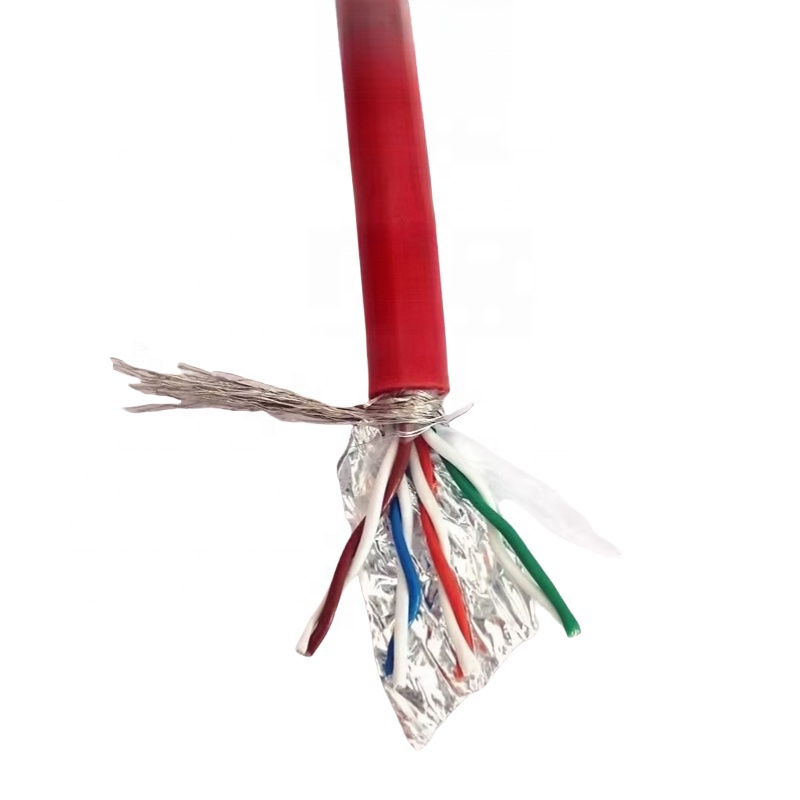
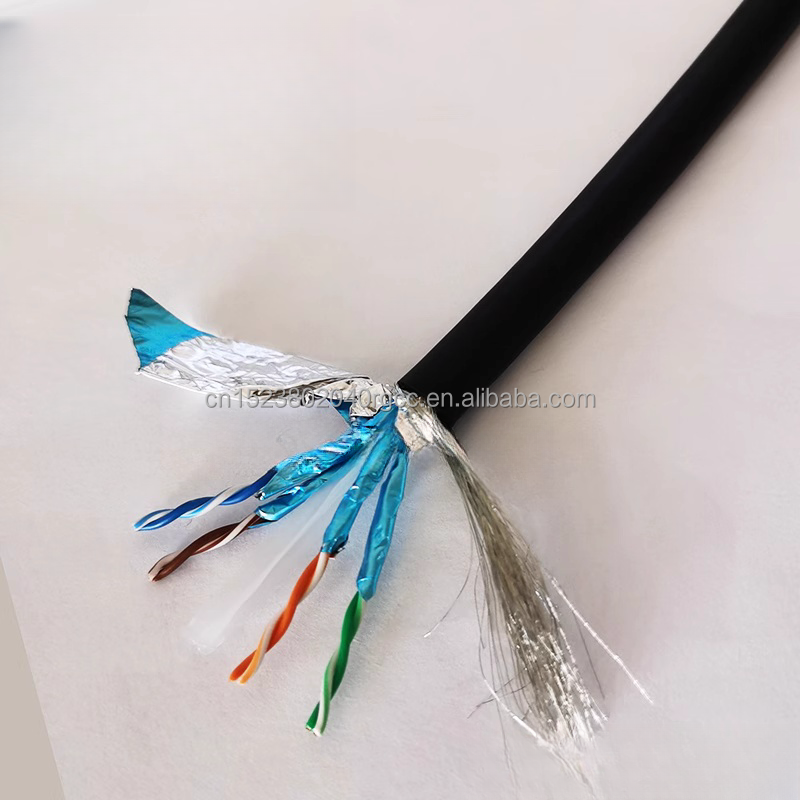
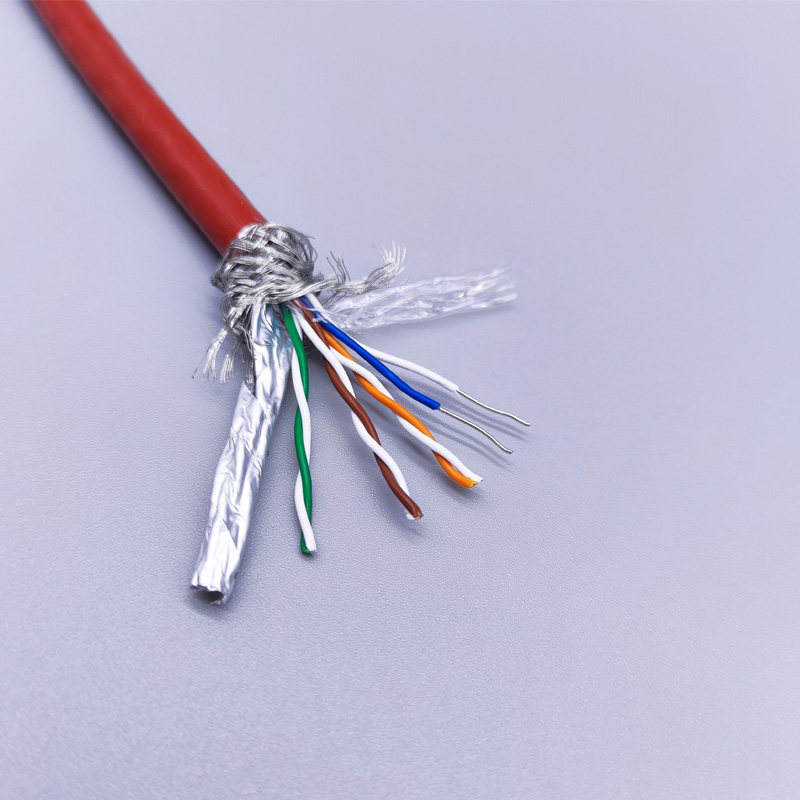
The High-Temp Silicone Ethernet Cable from Rousheng Cable is purpose-built for industrial networking environments where the combination of sustained elevated temperature, chemical exposure, and repeated mechanical flexing would rapidly degrade conventional PVC or LSZH cable assemblies. Manufactured with a cross-linked silicone rubber insulation and outer jacket system, this heat-resistant data cable carries network traffic reliably at operating temperatures between -60°C and +180°C — a thermal window wide enough to cover the full range from sub-zero outdoor storage through the hottest zones of an automotive paint-shop oven, food sterilisation tunnel, or turbine enclosure.
What distinguishes silicone rubber as a cable insulation material is the coexistence of properties that are mutually exclusive in conventional thermoplastics. At 180°C, silicone retains its elastomeric structure and dielectric characteristics — there is no softening point, no plasticiser migration, and no off-gassing of volatile organic compounds. Simultaneously, at -60°C, the same material remains pliable and routeable, a quality that PTFE cables cannot match. This dual thermal and mechanical versatility is what makes silicone-insulated Ethernet cable the first-choice specification in robotic arm wiring, festoon installations, cryogenic instrumentation, and anywhere that cables must flex repeatedly through wide temperature excursions.
High-Temp Silicone Ethernet Cable – Custom Core and Shield Options
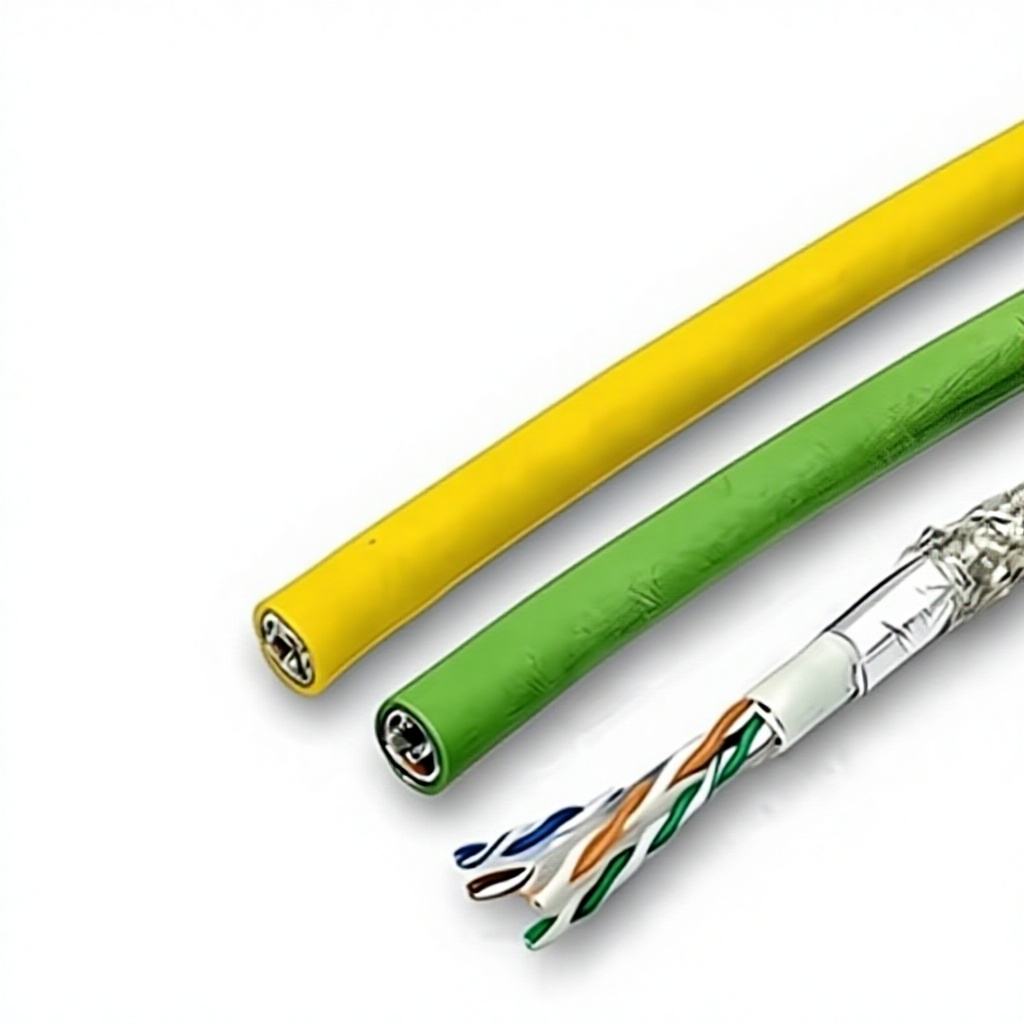
When network reliability cannot be compromised by heat, the High-Temp Silicone Ethernet Cable from Rousheng Cable delivers data transmission stability up to 180°C — without the rigidity of fluoropolymer alternatives. Built on a cross-linked silicone rubber insulation and jacket system, this heat-resistant Gigabit Ethernet cable combines genuine flexibility at both extremes of the temperature spectrum with a configurable core count and shield architecture, letting engineers match the cable to the exact demands of their installation rather than adapting the installation around a fixed cable format.
|
Max Temp |
Flexibility |
Core Options |
Shield Config |
Certifications |
|
180°C Cont. |
Soft to -60°C |
4P / 4P+2C / 4P+FO |
U/UTP · F/UTP · SF/UTP |
UL · CE · RoHS |
Product Line at a Glance
Three standard model families cover the most common deployment scenarios. All share the same silicone rubber dielectric and jacket system; they differ in core architecture and shielding level.
|
Model |
Core Structure |
Shield Type |
Cat Rating |
Max Temp |
Primary Use |
|
RS-SIL5e-U |
4 × twisted pair (U/UTP) |
None — unshielded |
Cat 5e · 100 MHz |
180°C |
General industrial Ethernet, low-EMI zones |
|
RS-SIL6-F |
4 × twisted pair (F/UTP) |
Overall Al-foil + drain wire |
Cat 6 · 250 MHz |
180°C |
Automation, inverter-dense environments |
|
RS-SIL6-SF |
4 × twisted pair (SF/UTP) |
Per-pair foil + overall TC braid |
Cat 6 · 250 MHz |
180°C |
High-EMI: VFD panels, welding cells, MRI |
|
RS-SIL6-C2 |
4P + 2 × coax cores |
Individual coax shields + overall braid |
Cat 6 · 250 MHz |
180°C |
Combo data + video / analogue signal |
|
RS-SIL6-FO |
4P + 2 × OM3 fibre cores |
F/UTP + armoured fibre sub-unit |
Cat 6 + OM3 |
180°C |
Long-run high-bandwidth hybrid links |
The Material Advantage: Why Silicone Rubber?
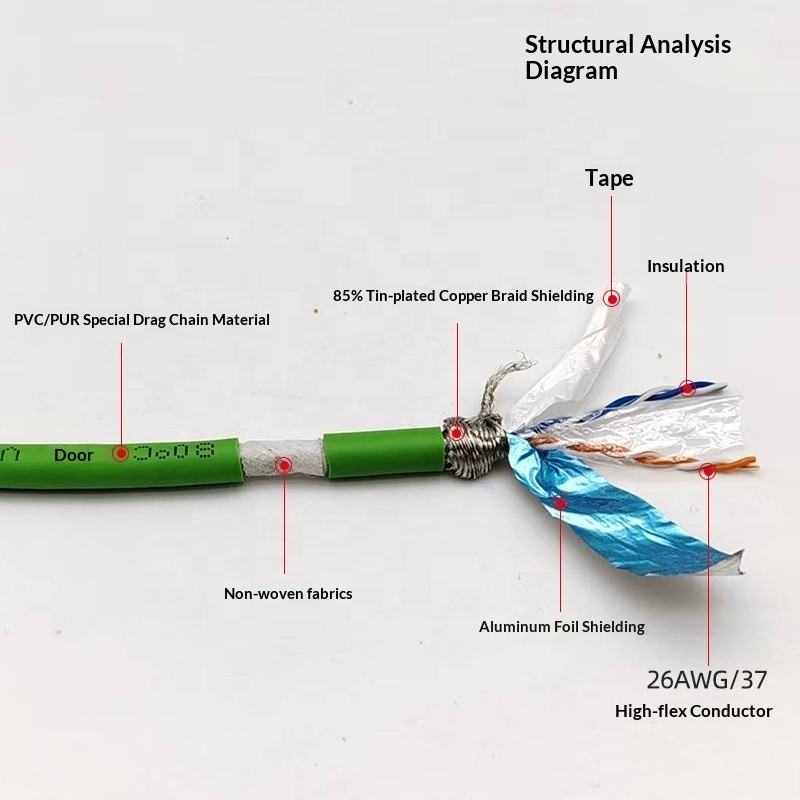
Industrial network designers selecting a heat-tolerant data cable face a choice between fluoropolymers (PTFE, FEP) and silicone rubber. Both withstand temperatures well beyond PVC or LSZH limits, but they serve different installation profiles.
Silicone rubber retains a Shore A hardness of 40–60 across its entire operating range — from -60°C to +180°C — whereas PTFE, while thermally superior, stiffens significantly below 0°C and is harder to route in tight-radius cable trays.
Key material properties that define this silicone-insulated Ethernet cable’s field behaviour:
- Thermal stability: Cross-linked silicone polymer maintains dielectric properties (εᵣ ≈ 2.7–3.0) from cryogenic storage through 180°C process heat — no phase transition, no outgassing of plasticiser compounds
- Flexibility advantage: Minimum bend radius of 6× OD even after prolonged thermal aging at 175°C, allowing installation in tight conduit bends and robot festoon systems without conductor fatigue
- Flame performance: Silicone rubber char-forms on ignition, creating an insulating residue that continues to carry low-current signals even after flame exposure — critical for circuit integrity in fire-event scenarios
- Moisture resistance: Water absorption < 0.1% by weight; suitable for steam-wash environments, high-humidity production floors, and outdoor installations without conduit
- Chemical profile: Resistant to dilute acids, alkalis, machine oils, and hydraulic fluid splashes common in metalworking and food-processing environments
- Non-toxic insulation: Silicone rubber does not require plasticisers or halogenated flame retardants, supporting clean-room and food-contact adjacent installations
Technical Specifications
Electrical Performance — All Models
|
Electrical Parameter |
RS-SIL5e-U / RS-SIL5e-F |
RS-SIL6-F / RS-SIL6-SF |
|
Characteristic Impedance |
100 Ω ± 15 Ω |
100 Ω ± 15 Ω |
|
Bandwidth |
100 MHz |
250 MHz |
|
Attenuation @ 100 MHz |
≤ 22.0 dB / 100 m |
≤ 19.8 dB / 100 m |
|
NEXT @ 100 MHz |
≥ 35.3 dB |
≥ 39.9 dB |
|
PSNEXT @ 100 MHz |
≥ 32.3 dB |
≥ 37.1 dB |
|
Return Loss @ 100 MHz |
≥ 20.1 dB |
≥ 20.1 dB |
|
DC Resistance (conductor) |
≤ 93.8 Ω / km |
≤ 93.8 Ω / km |
|
Mutual Capacitance |
≤ 56 pF / m |
≤ 56 pF / m |
|
Propagation Delay |
≤ 5.7 ns / m |
≤ 5.7 ns / m |
|
Delay Skew (pair-to-pair) |
≤ 50 ns / 100 m |
≤ 45 ns / 100 m |
|
Dielectric Withstand |
1 kV AC / 1 min |
1 kV AC / 1 min |
|
Insulation Resistance |
≥ 5,000 MΩ · km |
≥ 5,000 MΩ · km |
Mechanical & Environmental Properties
|
Parameter |
Value / Standard |
|
Conductor |
Fine-strand tinned copper, AWG 24 (Cat 5e) / AWG 23 (Cat 6) |
|
Conductor Stranding |
7 × 0.20 mm (Cat 5e) or 7 × 0.22 mm (Cat 6) |
|
Pair Insulation Material |
Cross-linked silicone rubber (SiR), wall thickness 0.25 mm |
|
Pair Lay Length |
13–40 mm (staggered per pair for NEXT reduction) |
|
Separator (Cat 6) |
Glass-fibre reinforced silicone spline — maintains pair geometry under flex |
|
F/UTP Foil Shield |
100% aluminium-polyester (Al-PET) laminate + tinned Cu drain wire |
|
SF/UTP Braid |
Tinned copper braid, ≥ 65% optical coverage over individual foil-shielded pairs |
|
Outer Jacket |
Extruded cross-linked silicone rubber, grey (RAL 7035 standard) |
|
Jacket Thickness |
1.0 mm (Cat 5e U/UTP) / 1.2 mm (Cat 6 shielded variants) |
|
Overall Diameter |
6.8 mm (RS-SIL5e-U) · 7.6 mm (RS-SIL6-F) · 8.4 mm (RS-SIL6-SF) |
|
Operating Temp Range |
-60°C to +180°C (continuous); +200°C short-term peak (≤ 30 min) |
|
Min Bend Radius (fixed) |
4 × OD |
|
Min Bend Radius (flex) |
8 × OD (rated for 500,000+ flex cycles at 8× OD) |
|
Tensile Strength |
≥ 6.5 MPa (jacket) per IEC 60811-501 |
|
Elongation at Break |
≥ 150% (jacket) per IEC 60811-501 |
|
Flame Rating |
IEC 60332-1 (single vertical) standard; IEC 60332-3 bunched optional |
|
Oil Resistance |
IRM 902 test oil immersion 24h at 100°C — < 15% mass change |
|
Approvals |
UL Listed (E-file) · CE Marked · RoHS 3 Compliant · IEC 61156-5/6 |
Shield Configuration Guide — Choose the Right Architecture
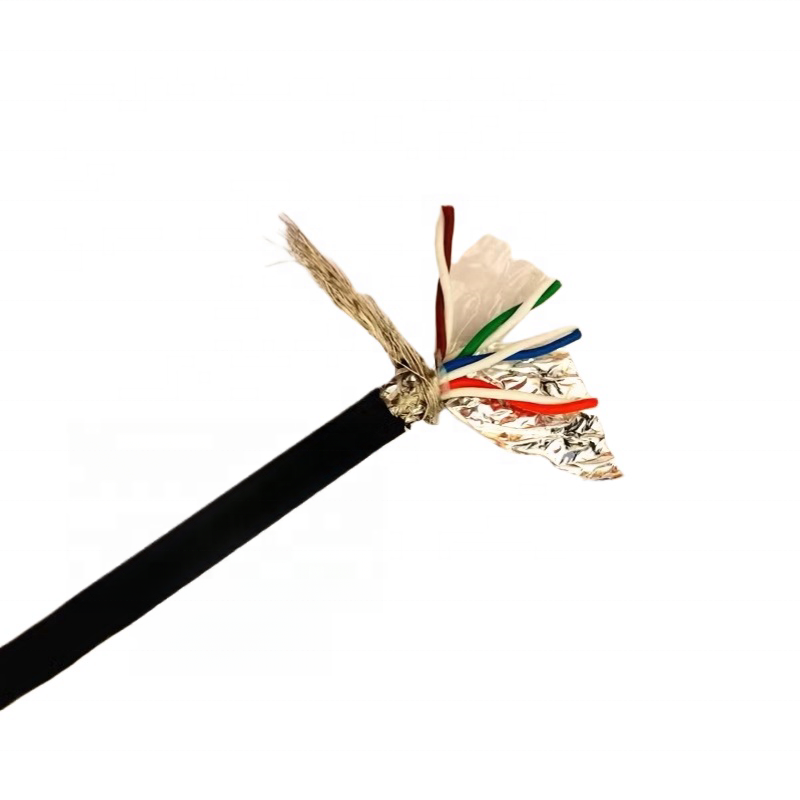
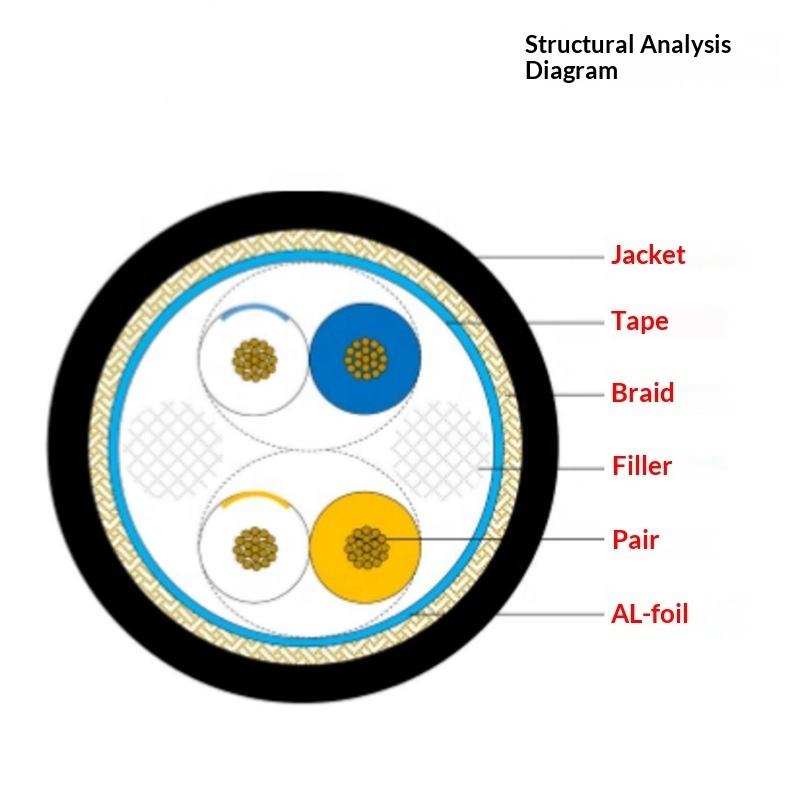
The shielding structure is the most consequential variable in a silicone Ethernet cable order. The table below maps installation environment to the recommended configuration:
|
Configuration |
Structure |
EMI Suppression |
Ground Req. |
Best For |
|
U/UTP |
Unshielded pairs, no overall shield |
None — relies on cable geometry |
Earth via switch |
Low-EMI factory areas, office-adjacent zones |
|
F/UTP |
Overall Al-PET foil + drain wire |
30–40 dB (100 kHz–30 MHz) |
Single-point drain |
Inverter rooms, servo drive cabinets, induction heating |
|
SF/UTP |
Per-pair foil + overall TC braid |
55–70 dB (1 MHz–1 GHz) |
Both ends bonded |
Welding cells, plasma equipment, MRI suites, defence |
|
Ind. Pair + Overall Braid |
Individual pair foil shields + outer TC braid |
65–85 dB (1 MHz–1 GHz) |
Both ends, low impedance |
High-frequency interference sources, RF environments |
Engineering note: In most industrial Ethernet installations the F/UTP configuration offers the best balance between shielding performance and installation practicality. SF/UTP should be specified when the cable runs within 300 mm of high-current busbars, VFD output cables, or welding return conductors.
Where This Cable Is Deployed
The defining characteristic of a high-temperature silicone Ethernet cable is not merely its heat rating but the combination of thermal endurance and soft, cold-weather flexibility that silicone rubber uniquely provides. This dual capability opens deployment opportunities that neither PTFE nor PVC alternatives can serve equally well.
|
Sector |
Specific Environment |
Why Silicone Ethernet Cable |
|
Automotive Manufacturing |
Paint-shop body ovens (160–180°C), weld fixtures |
Stays flexible for drag-chain routing through oven entry/exit zones; handles repeated thermal cycling without jacket cracking |
|
Food & Beverage |
Tunnel pasteurisers, steam-in-place CIP lines, retort vessels |
Steam-wash compatible; no plasticiser migration near food-contact surfaces; FDA-adjacent silicone compounds available |
|
Renewable Energy |
Solar tracker motor cabinets, offshore wind turbine nacelles |
Survives outdoor UV exposure and coastal salt-spray without surface crazing; -60°C cold flex for Arctic deployments |
|
Glass & Ceramics |
Roller hearth kiln instrumentation, glass annealing lehr networks |
Silicone rubber retains insulation integrity if momentarily exposed to radiant heat spikes during kiln door opening |
|
Medical Equipment |
Sterilisation autoclave chambers, surgical lamp systems |
Biocompatible silicone compounds; withstands repeated steam sterilisation at 134°C; halogen-free for indoor air quality |
|
Robotics & Automation |
Collaborative robot (cobot) arm wiring, automated welding cells |
Rated for 500,000+ flex cycles at 8× OD; low-drag jacket surface reduces fatigue in festoon and drag-chain installations |
|
Power Generation |
Gas turbine enclosure instrumentation, diesel genset panels |
Tolerates engine-bay temperatures up to 180°C; oil-resistant jacket handles lubrication spray common in turbine enclosures |
|
Defence & Simulation |
Armoured vehicle electronics bays, flight simulator motion bases |
Wide temperature range (-60°C to +180°C) handles harsh transport and deployment environments; SF/UTP variant meets TEMPEST EMC requirements |
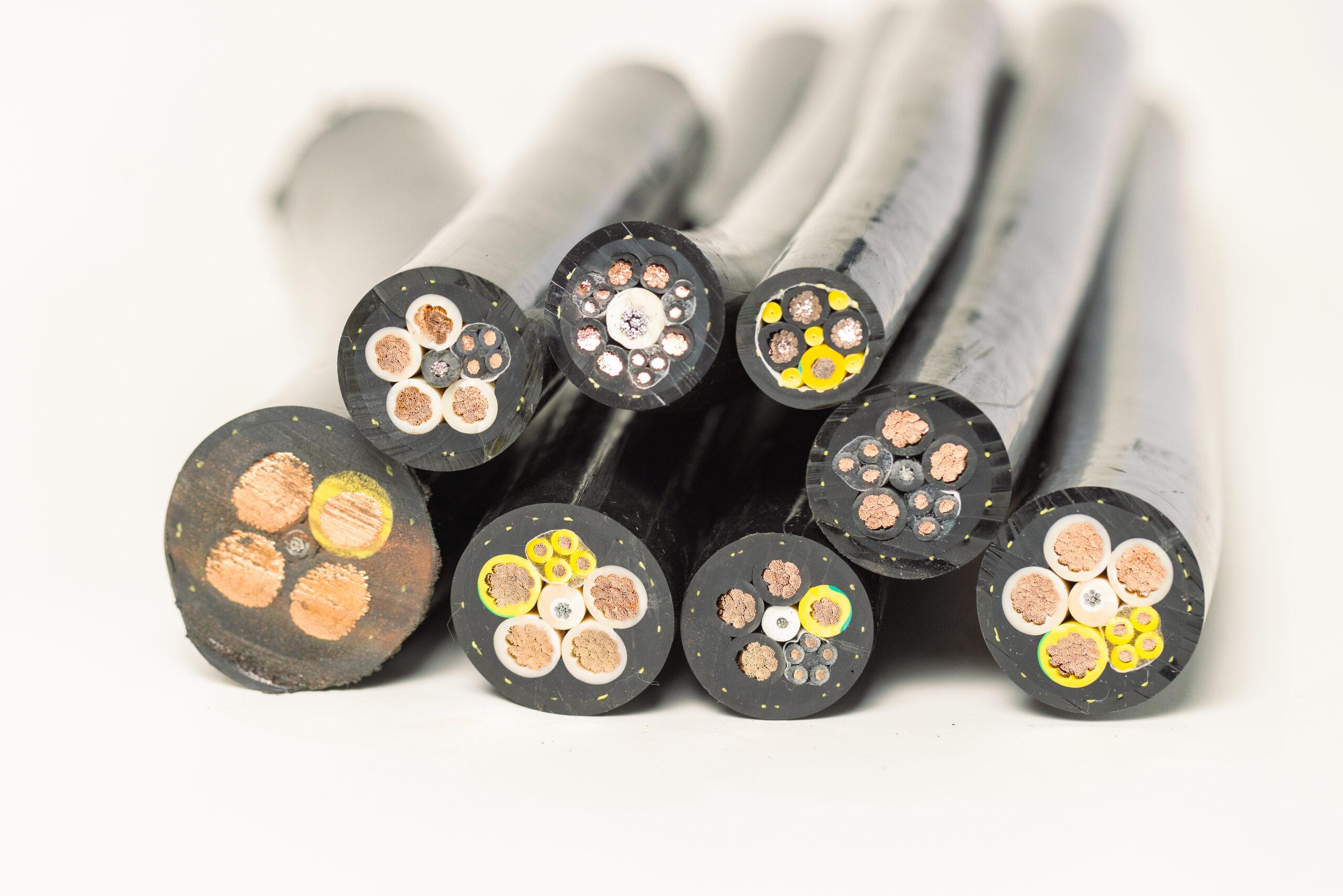
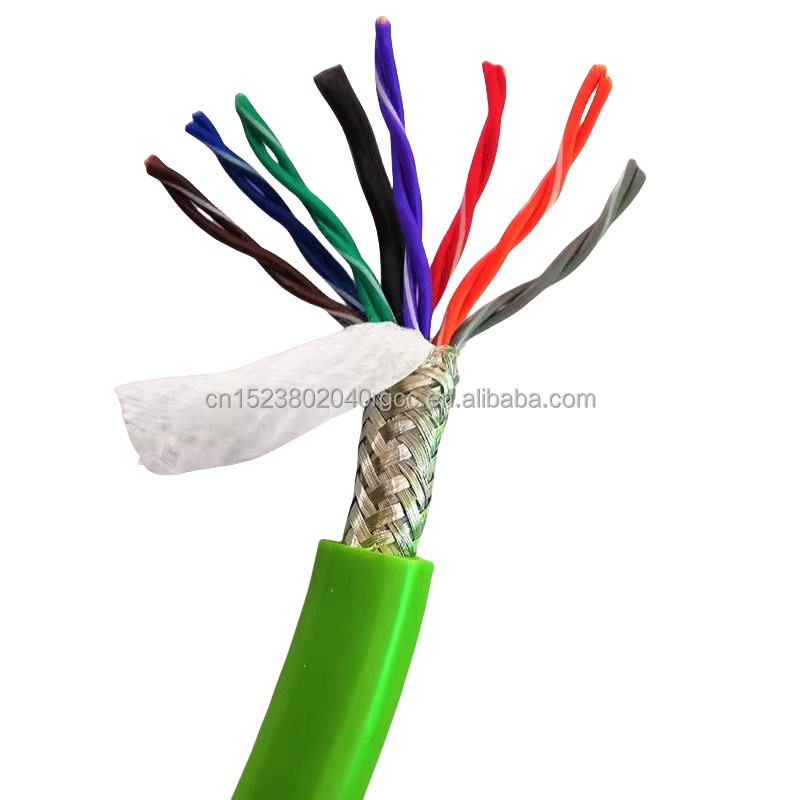
Custom Core Architecture — Beyond Standard 4-Pair Ethernet
Many industrial installations require data, power, and sensor signals to share a single cable run. Rousheng’s custom core options integrate additional conductors within the same silicone-jacketed cable assembly:
|
Core Configuration |
Additional Elements |
Recommended Application |
|
4P Standard |
4 twisted pairs only |
Pure Ethernet data — switch to switch, PLC to HMI, IP camera feeds |
|
4P + 2C (RS-SIL6-C2) |
4 Ethernet pairs + 2 individually shielded 75 Ω coaxial cores |
Simultaneous Ethernet and analogue video or RS-485 sensor signal on one cable run |
|
4P + 2×0.75 mm² Power |
4 Ethernet pairs + 2-core 0.75 mm² tinned copper power conductors |
PoE++ supplement or 24 V DC auxiliary power for remote sensors alongside Ethernet data |
|
4P + FO (RS-SIL6-FO) |
4 Ethernet pairs + 2 OM3 50/125 µm fibre cores in tight-buffered sub-unit |
Long-run links (> 100 m) combining copper Ethernet for close equipment + fibre for backbone segment |
|
4P + 2T (PT100) |
4 Ethernet pairs + 2-core screened thermocouple extension wire |
PLC-to-field-device wiring where temperature measurement and network data share one conduit path |
Custom core combinations not listed above are available against project specification. Minimum order quantity for custom core builds is 100 m. Contact our engineering team with your schematic or load list for a quotation and sample lead time.
Installation and Handling Guidelines
Correct installation practice preserves the long-term performance of any heat-resistant silicone Ethernet cable. Follow these guidelines to avoid field failures:
- Maintain a minimum bend radius of 4× OD during fixed installation. For continuous flex (drag chain, festoon), never reduce below 8× OD.
- Do not over-pull. Maximum installation pull tension is 80 N (Cat 5e) and 110 N (Cat 6). Use cable lubricant when pulling through conduit lengths exceeding 20 m.
- Terminate shielded variants with metal-bodied RJ45 connectors or M12 D-coded connectors. Plastic housings prevent shield bonding and defeat the EMI protection.
- For F/UTP variants, connect the drain wire at the switch or patch panel end only (single-point grounding). For SF/UTP and individual-pair-shielded variants, bond both ends to ground for optimal high-frequency suppression.
- In environments where mechanical damage is possible (forklift traffic, foot-fall zones), supplement with stainless-steel flexible conduit. Silicone rubber is abrasion-tolerant but not abrasion-proof.
- Allow thermal expansion: secure cable every 500 mm in high-temperature zones, using silicone-compatible cable ties or stainless-steel clamps. Avoid nylon ties in environments above 85°C — they embrittle.
- When routing through oven walls or thermal barriers, use a certified feed-through gland rated to at least 200°C. The cable’s temperature rating does not cover the gland or termination hardware.
Frequently Asked Questions
Q1 — What is the difference between this silicone cable and a PTFE Ethernet cable for high-heat use?
PTFE offers a higher continuous temperature ceiling (200°C vs. 180°C) and a lower dielectric constant (2.1 vs. 2.7–3.0), which translates to marginally lower signal attenuation per 100 m. However, PTFE cable is significantly stiffer below 20°C and harder to route in tight-radius trays or through drag-chain systems. Silicone rubber remains supple at -60°C, making it the better choice wherever flexibility matters as much as heat resistance — particularly in robotics, festoon applications, and outdoor installations in cold climates.
Q2 — Can this cable support Power over Ethernet (PoE)?
Yes. All 4-pair variants support IEEE 802.3bt PoE++ (90 W, Type 4) when paired with a compliant switch and end device. The silicone rubber jacket’s superior thermal dissipation versus PVC actually improves PoE performance in enclosed cable trays, where heat build-up from multiple PoE cables can degrade PVC cable performance. The RS-SIL6-F and RS-SIL6-SF variants are preferred for PoE++ deployments due to their tighter pair geometry and lower DC resistance.
Q3 — Is the silicone jacket food-safe or suitable for pharmaceutical environments?
Standard RS-SIL series cables use industrial-grade silicone rubber that is not food-contact certified. For food-adjacent or pharmaceutical clean-room applications, we offer an FG (Food Grade) variant using silicone compound compliant with FDA 21 CFR 177.2600 and EU 10/2011 for incidental contact. The FG variant also omits carbon-black pigment from the jacket, producing a translucent-white surface that makes contamination visible. Please specify the -FG suffix when ordering for these sectors.
Q4 — What connector options are factory-available for this cable?
Factory termination options include: (a) Metal-shelled Cat 6 RJ45 with silicone strain-relief boot (rated to 100°C at the termination point); (b) M12 D-coded 4-pin straight or angled plug/socket, IP67 rated, stainless steel housing (rated to 130°C); (c) M12 X-coded 8-pin for 10 Gigabit Ethernet on the Cat 6A variant; (d) bare stripped-and-tinned end for field termination. All connector assemblies are 100% wire-mapped and tested to IEC 61156 before shipment.
Q5 — How many flex cycles will the cable withstand in a drag-chain application?
Validated at 500,000 flex cycles at 8× OD bend radius, 1 m travel, 20-cycle-per-minute rate at 23°C. At elevated temperature (100°C), cycle life is de-rated to approximately 350,000 cycles. For high-speed, small-radius drag chains — particularly those with accelerations above 5 m/s² — specify the -HC (High Cycle) variant with a reinforced PTFE-filled silicone jacket and cross-helically wrapped Kevlar strain-relief layer. The HC variant is validated to 2 million cycles.
Q6 — Is the cable UV-stable for outdoor routing?
Standard RS-SIL cables use a UV-stabilised silicone rubber outer jacket that passes IEC 60811-401 UV aging test (720 hours xenon arc). Surface hardness and tensile properties degrade less than 15% after test, confirming suitability for outdoor installations exposed to direct sunlight. For coastal and offshore environments, the SF/UTP shielded variant is recommended to protect the Al-PET foil and copper braid from salt-mist corrosion through any micro-defect in the jacket.
Q7 — What documentation is provided with each order?
Every order ships with: production batch test report (wire map, impedance TDR trace, attenuation, NEXT, insulation resistance); material safety data sheet (MSDS/SDS) for the silicone jacket compound; CE Declaration of Conformity; and RoHS 3 compliance declaration. ISO 9001 factory audit reports and third-party test certificates (UL, TÜV, SGS) are available on request for orders ≥ 500 m.
Request a Sample or Quotation
Custom lengths, non-standard core configurations, and connector-terminated assemblies are all available. To receive a fast, accurate quote, please provide the following when contacting us:
- Cable model (RS-SIL5e-U, RS-SIL6-F, RS-SIL6-SF, RS-SIL6-C2, RS-SIL6-FO, or custom)
- Shield configuration (U/UTP, F/UTP, SF/UTP, or individual-pair)
- Total length required and number of cuts
- Termination: bare end, RJ45, or M12 (specify gender and keying)
- Operating environment: temperature range, chemical exposure, flex cycle estimate
- Delivery address and required date
📧 Jerry@rstlkable.com | 📞 +86-021-50759965 |
Manufacturer Background & Quality Credentials
Shanghai Rousheng Wire and Cable Co., Ltd. is a specialty cable manufacturer based at No. 2591 Fengzhe Road, Fengxian District, Shanghai. The company holds ISO 9001:2015 quality management certification and carries an AAA enterprise credit rating from the China Credit Enterprise Evaluation Association. Rousheng’s product portfolio spans more than 100 cable types, including ROV umbilical cables, neutral buoyancy subsea cables, PTFE-insulated Ethernet cables, high-flex drag-chain cables, and this range of silicone-rubber-jacketed network cables.
All incoming silicone compound batches are tested for Shore A hardness, tensile strength, and heat aging resistance before production. Finished cable undergoes electrical characterisation to IEC 61156, plus thermal soak testing at rated temperature. The production facility includes IEC-calibrated TDR impedance analysers, high-voltage test benches, and a thermal cycling chamber — enabling us to issue per-batch test reports that support customer commissioning and regulatory compliance documentation.