

Cat 5 Elevator Traveling Cable for CCTV: Uses, Limits, and Selection Guide
When people search for Cat 5 elevator traveling cable, they are usually not looking for a generic explanation of elevator cable. They are trying to solve a more specific problem: Can Cat 5 be used inside a moving lift system for CCTV or communication, and if so, when is it the right choice? That is an important question, because the answer depends on more than just bandwidth. In an elevator, the cable must move, hang, bend, and survive years of repeated travel. A cable that works perfectly in a fixed network installation may fail early in a lift shaft if it is not designed for dynamic service.
That is why Cat 5 in an elevator should never be treated like ordinary building data cable. In a lift system, the cable is not only a transmission medium. It is also a moving mechanical component. If the wrong cable is selected, the result may look like a CCTV problem, an intercom problem, or a camera fault, when the real cause is the cable itself: conductor fatigue, unstable hanging behavior, repeated bending stress, or signal loss under motion.
This guide explains what Cat 5 elevator traveling cable is, what it is used for, when it makes sense for lift CCTV and communication, when Cat 5e or Cat 6 may be better, and what problems usually appear when the wrong type is installed. It is written for elevator contractors, CCTV integrators, lift manufacturers, distributors, project buyers, and maintenance teams who need practical decision support rather than a generic product overview.
What is Cat 5 elevator traveling cable?
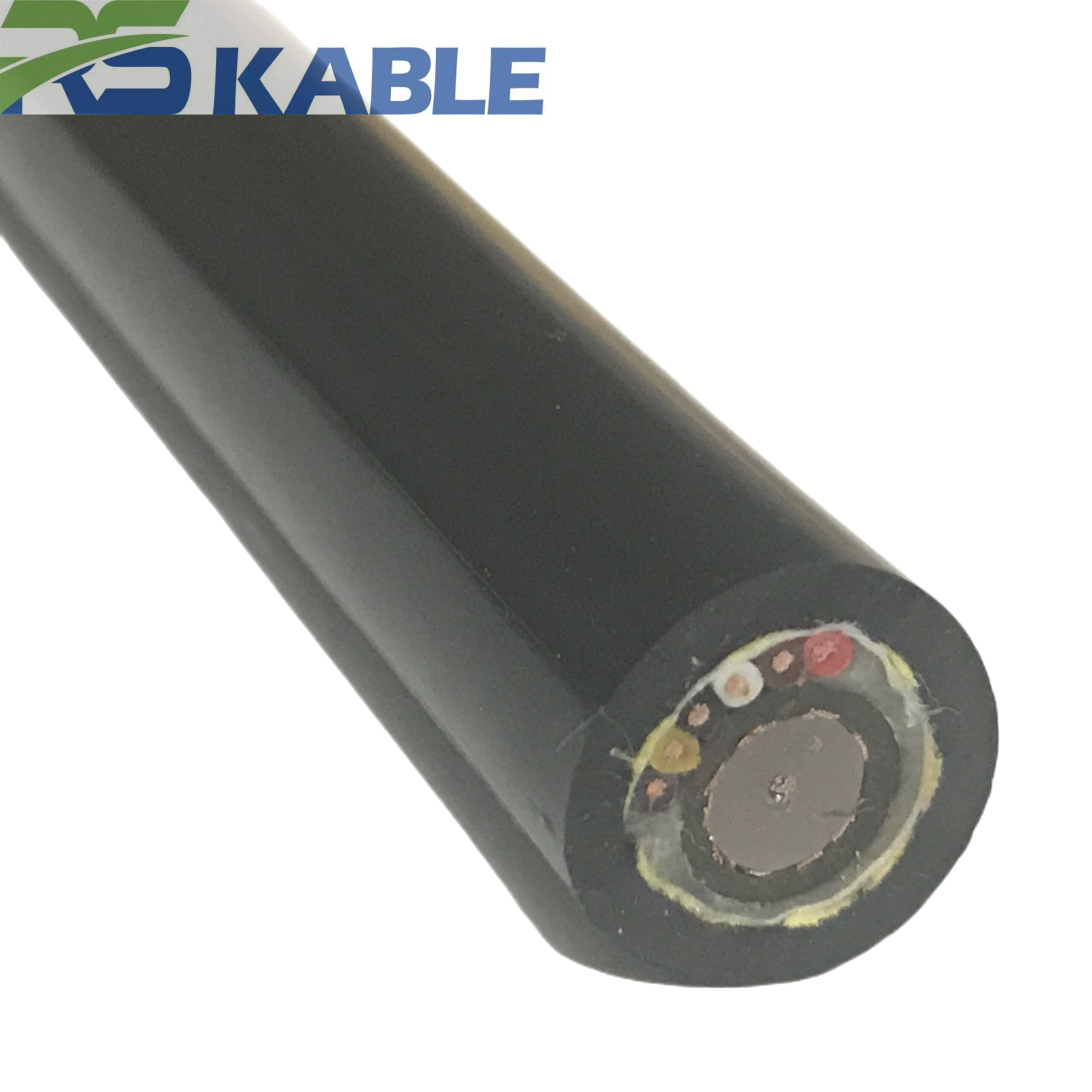
A Cat 5 elevator traveling cable is a lift-rated moving cable that includes Cat 5 communication pairs within a traveling cable structure designed for elevator motion. In practical terms, it combines two different requirements:
-
the communication function of Cat 5 cable
-
the mechanical movement function of an elevator traveling cable
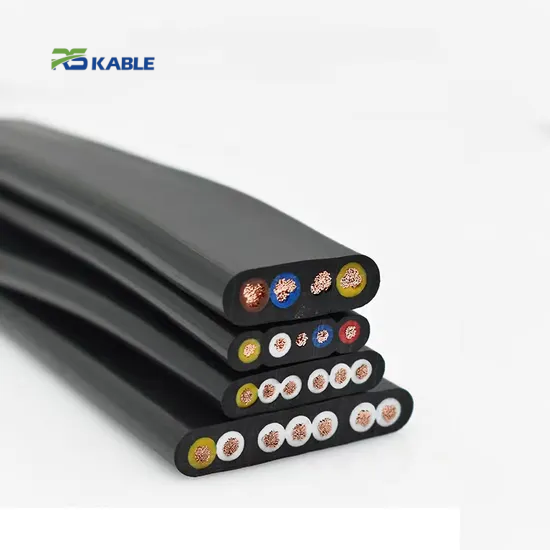
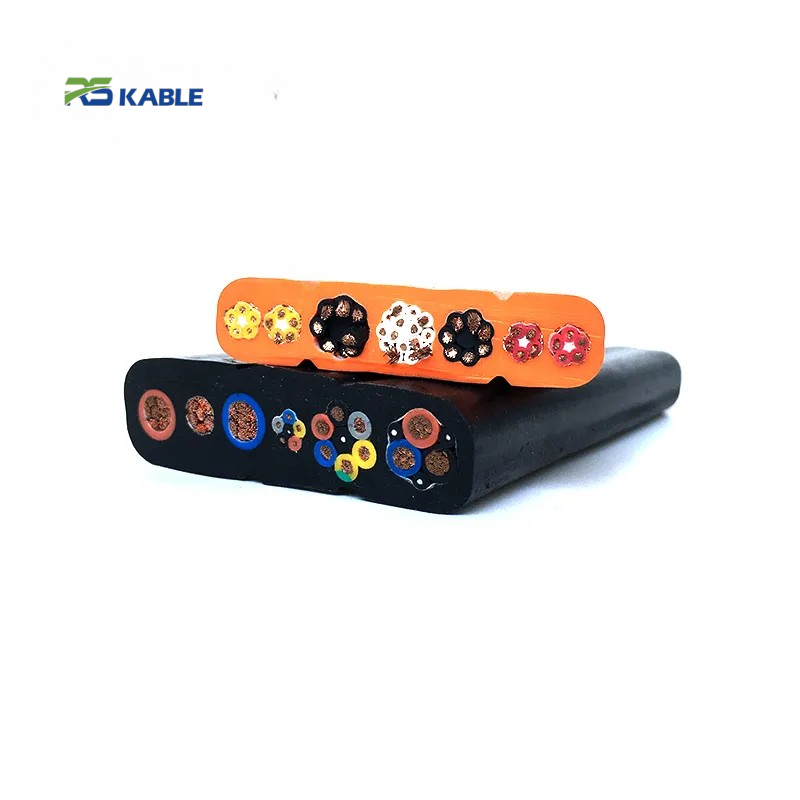
That distinction matters. A standard Cat 5 cable is usually made for fixed network installation. A true Elevator Traveling cable is designed to move continuously with the lift car. When those two functions are combined correctly, the result is a cable that can support communication systems such as CCTV, intercom, or monitoring links while still tolerating repeated elevator travel.
In many projects, this type of cable may also include additional conductors for power, control, alarm, or other communication needs. So the product is often not “just Cat 5.” It is a hybrid lift cable that uses Cat 5 pairs as part of a broader elevator communication design.
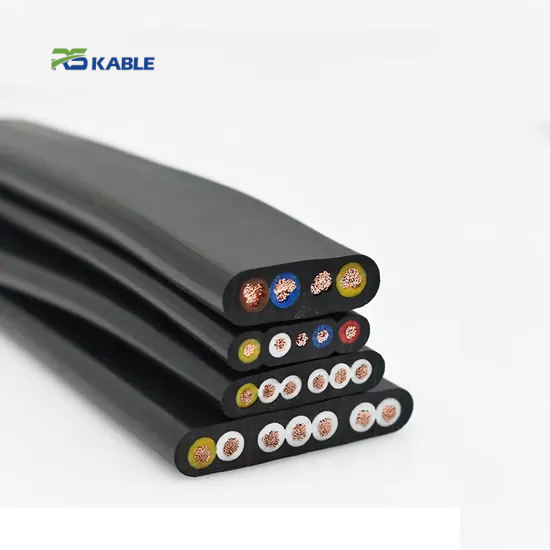
12-Core 0.5mm² Heavy-Duty Flat Cable for Crane & Hoist Systems | Industrial Grade
This high-flex 12-core flat cable is engineered for **crane, hoist, and elevator systems**, featuring **12 × 0.5mm² finely stranded copper conductors**, an **anti-twist flat profile**, and an **oil- and abrasion-resistant sheath** for smooth, tangle-free operation and long service life in heavy-duty industrial environments.
Why would an elevator use Cat 5 at all?
This is the first real buying question. The reason is simple: many lift systems now need stable communication paths for equipment inside the car.
Common uses include:
-
CCTV cameras inside the lift car
-
intercom or emergency communication
-
remote monitoring devices
-
access control or card reader links
-
cabin display or digital communication systems
-
building management integration
In many of these applications, Cat 5 is considered because it is familiar, practical, and suitable for communication tasks that do not necessarily require a higher-specification network cable. For some projects, especially those focused on elevator CCTV or basic data communication, Cat 5 may be fully adequate when it is part of a proper lift-rated design.
The key phrase there is lift-rated design. Cat 5 alone is not enough. It must be built into an elevator-traveling cable structure that is suitable for motion.
Why ordinary Cat 5 cable is usually not enough for a lift
This is where many low-budget or poorly planned projects go wrong. A buyer may think: “I only need a camera feed or a communication line, so standard Cat 5 should work.” Electrically, that assumption may seem reasonable. Mechanically, it is often wrong.
A lift cable must endure:
-
vertical hanging over significant distance
-
repeated bending during every trip
-
vibration and acceleration
-
stress concentration near fixing points
-
long-term motion fatigue
A standard indoor Cat 5 cable is not designed for that environment. Even if it carries data perfectly during a bench test, it may fail much sooner than expected in actual elevator service.
That is why a true Elevator Traveling cable is not just a data cable with a different label. It is a movement-rated cable built for long-term lift duty.
The real role of Cat 5 in lift CCTV systems
Many users searching this topic are specifically concerned with CCTV. So it is worth being direct here: Cat 5 is often used in lift CCTV systems because it provides a practical communication medium for video transmission and related low-voltage functions. But its suitability depends on the system architecture.
In some projects, Cat 5 may support:
-
camera data or signal transmission
-
digital monitoring connections
-
communication between lift car devices and external systems
-
integrated security functions
In other projects, especially those with higher bandwidth, more demanding image quality, or more complex building integration, Cat 5e or Cat 6 may be preferred instead.
That means the correct question is not simply “Can Cat 5 be used?” The better question is: Is Cat 5 sufficient for this specific elevator CCTV application, given the travel height, usage frequency, and communication requirements?
Cat 5 vs Cat 5e vs Cat 6 in elevator traveling cable
This is one of the most important comparison sections for SEO and for actual buyers.
When Cat 5 can still be a practical choice
Cat 5 may still be reasonable when:
-
the CCTV requirement is moderate
-
the communication load is not especially high
-
the system is not designed for very advanced smart-building integration
-
the lift is not part of a high-complexity digital network upgrade
-
the supplier offers a true traveling-cable design, not just ordinary Cat 5
In these cases, Cat 5 can be a cost-effective and practical communication element inside a lift cable.
When Cat 5e may be the better option
Cat 5e is often preferred when:
-
the project wants stronger performance margin
-
communication stability matters over the long term
-
the system may later add more digital functions
-
the CCTV link is expected to be more demanding
-
the building owner wants a more future-ready specification without jumping too far in cost
For many modern lift CCTV installations, Cat 5e is often seen as the more balanced option.
When Cat 6 may be worth considering
Cat 6 usually makes more sense when:
-
the system is part of a more advanced building network environment
-
the project requires higher-performance communication support
-
long-term scalability is a major goal
-
multiple digital functions are integrated into the lift system
-
future upgrade margin is prioritized over lowest cost
However, higher category does not automatically mean better if the mechanical cable design is wrong. A poorly built Cat 6 cable that is not truly lift-rated may still perform worse than a well-designed Cat 5 traveling cable.
Real failure scenarios: when the wrong Cat 5 elevator cable is used
This is where the topic becomes more practical and more credible.
1. The camera image drops only while the lift is moving
This is one of the most common field complaints. The CCTV feed looks normal while the lift is stationary, but becomes unstable during movement. Many people first blame the camera or recorder, but the real cause is often cable stress under motion.
Typical root causes include:
-
conductor fatigue
-
unstable pair integrity
-
poor cable design for repeated bending
-
stress near fixing points
2. The system works for months, then becomes intermittent
This often happens when a general-purpose cable is used in place of a true traveling cable. The cable survives commissioning and early operation, then gradually degrades under repeated vertical travel.
3. One lift has problems, but another identical lift does not
In practice, this may be caused by installation differences rather than equipment differences. One shaft may create more mechanical stress, sharper routing, or worse suspension behavior than another.
4. Upgrading to IP-based CCTV causes unexpected cable-related issues
Some modernization projects assume that if Cat 5 is present, the system is ready for any new camera architecture. That is not always true. Communication category and movement-rated structure are two different issues, and both must be correct.
These failure scenarios are exactly why Cat 5 in an elevator must be specified as part of a motion system, not just a communication link.
Selection matrix: how to choose the right cable
A better buying decision comes from looking at three variables together.
1. Travel height
Low- to medium-rise lifts
In shorter travel systems, Cat 5 may still be practical if the communication requirement is moderate and the cable is truly lift-rated.
High-rise lifts
As height increases, hanging behavior and long-term fatigue become much more critical. This is where many buyers should consider a stronger overall design and, in some cases, a higher communication category if future demand is uncertain.
2. Duty cycle
Lower-use residential lifts
The cycle count may be lower, but the cable still needs to be built for movement. Do not confuse “lower use” with “ordinary cable is fine.”
High-traffic commercial lifts
In office towers, hospitals, hotels, and public facilities, repeated motion puts far more stress on the cable. This is where long-term movement reliability should outweigh initial price savings.
3. Function mix
CCTV only
If the cable mainly supports a single CCTV function, Cat 5 may be adequate in some projects.
CCTV plus intercom, monitoring, or future integration
If the lift may later support multiple communication functions, buyers should think ahead. In these cases, Cat 5e or Cat 6 may offer a better long-term margin, provided the cable remains truly lift-rated.
What to ask a supplier before buying
A reliable supplier should ask more than just “How many pairs do you need?”
The right questions include:
-
What is the lift travel height?
-
Is this a new installation or modernization project?
-
Is the cable for CCTV only, or also intercom and monitoring?
-
How busy is the elevator?
-
Is future network expansion likely?
-
Is a Cat 5 design sufficient, or should the project move to Cat 5e or Cat 6?
-
Is the product a genuine Elevator Traveling cable or only a communication cable?
If those questions are not being asked, the recommendation may be too generic to trust.
Common mistakes buyers make
Mistake 1: Assuming all Cat 5 cables are the same
They are not. Ordinary building Cat 5 and lift-rated Cat 5 traveling cable are completely different in mechanical application.
Mistake 2: Choosing only by cable category
Category is important, but it is not the only factor. A better category does not compensate for the wrong traveling-cable structure.
Mistake 3: Ignoring future integration
If the building may later add more communication functions, selecting a cable with no upgrade margin may become a limitation.
Mistake 4: Blaming the CCTV equipment first
In many field cases, intermittent video faults are actually cable movement problems.
Mistake 5: Buying only by price
Replacing a cable inside a lift system is not a trivial maintenance task. Lifecycle cost matters more than first quote.
FAQ
What is Cat 5 elevator traveling cable used for?
It is used for elevator communication functions such as CCTV, intercom, monitoring, and other low-voltage data connections inside a moving lift system.
Can I use ordinary Cat 5 cable in an elevator?
In most cases, that is not recommended. Standard Cat 5 is usually not designed for repeated elevator motion and long-term hanging stress.
Is Cat 5 enough for elevator CCTV?
Sometimes, yes. It depends on the communication requirement, travel height, duty cycle, and whether the cable is truly lift-rated.
Should I choose Cat 5, Cat 5e, or Cat 6 for a lift?
Cat 5 may be enough for simpler systems, Cat 5e is often a more balanced modern choice, and Cat 6 may be better where higher performance or future expansion matters.
Why does elevator CCTV fail while the lift is moving?
A common reason is that the cable is not properly designed or installed for traveling duty, causing signal instability under motion.